|
|
EUROPEAN COMPOST NETWORK
ECN e.V.
|
Network for Organic Resources and Biological Treatment
|
|
|
|
|
|
|
ECN E-BULLETIN No. 5_2026
|
|
|
|
|
|
|
European Commission | Fertiliser Action Plan
|
Publication of the Commission’s Fertiliser Action Plan
|
|
|
|
The European Commission published on 19 May its Fertiliser Action Plan, which aims, in the face of rising prices for mineral fertiliser, to ensure the availability and affordability of domestic fertilisers and propose actions enabling transition towards recycled nutrients and other alternatives.
|
|
The Action Plan recognises the regulatory and market-entry barriers faced by bio-based fertilisers, especially when they are derived from waste, and recognises the fragmentation of the single-market for bio-based fertilisers. It provides a wide range of short-term and long-term actions concerning bio-based fertilisers. In the short-term, the Commission wants to facilitate the use of digestates. In the long-term, the Commission aims to:
|
- Provide definitions of bio-based fertilisers.
- Create lead markets for bio-based fertilising products in the forthcoming Biotech Act II.
- Work to simplify the management of animal by-products intended for anaerobic digestion or composting and facilitate the marketing and use of bio-based fertilisers of animal origin.
- Give the possibility for Member States to use State aid instruments to support farmers to use and uptake bio-based (organic) fertilisers.
- Work on phosphorus and nitrogen recovery from relevant organic waste streams, including bio-waste, and assess the possibility to set nutrient recycling targets.
- Use the CAP and the Cohesion policy to support the separate collection and treatment of municipal bio-waste and the deployment of related bio-based fertilisers.
- Possibly extend the RENURE derogation to digestates, with appropriate environmental safeguards.
|
Launch of an EU-wide call for Carbon Removals and Carbon Farming projects that compensate farmers for the additional costs of bio-based fertilisers.
|
|
|
|
|
|
|
Nutrient Recycling Conference I 28–29 April 2026
|
ESNI-NERM 2026 Conference: Advancing Nutrient Recycling in Europe
|
|
Held in Brussels and organised by the Biorefine Cluster Europe and the European Sustainable Phosphorus Platform, the ESNI-NERM 2026 Conference brought together researchers, Commission officials, industry representatives, and practitioners to discuss the future of nutrient recycling and bio-based fertilisers (BBFs) in Europe.
|
|
The conference featured discussions on legislative initiatives such as the Multiannual Financial Framework (MFF) and the EU Biotech Act II, alongside presentations from bio-based fertiliser companies, EU-funded projects, and technology developers. Discussions focused on practical solutions to increase the market demand, competitiveness, and adoption of BBFs, particularly in response to ongoing challenges linked to mineral fertiliser availability and prices in European agriculture.
|
|
|
|
|
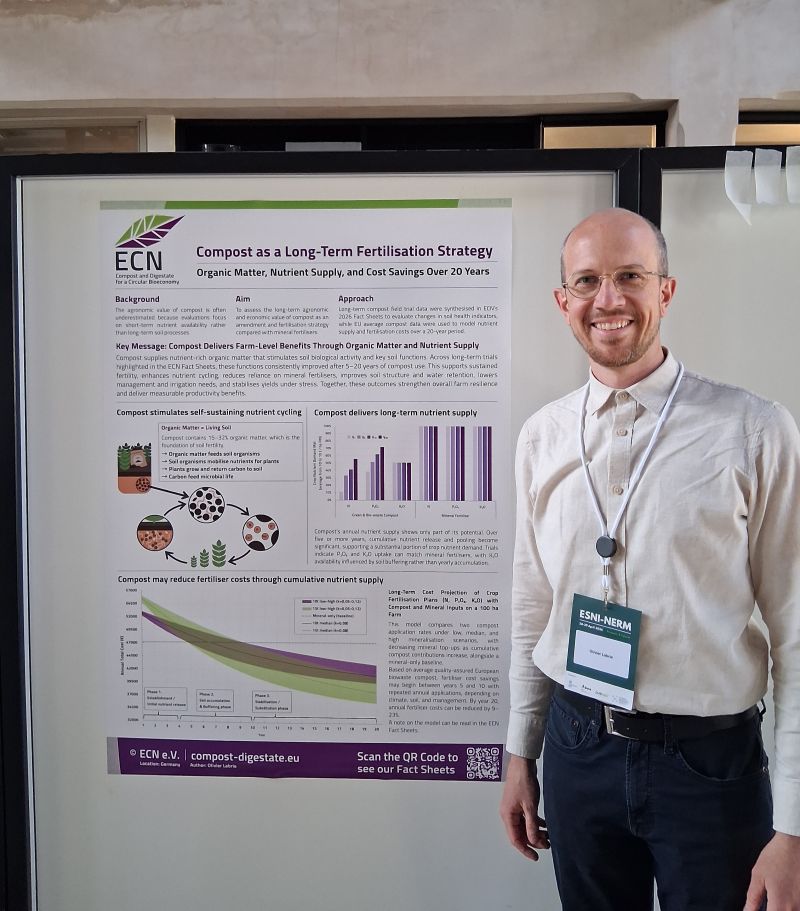
A key contribution came from Olivier Labrie, ECN’s Project Officer for Agriculture, who presented evidence showing that repeated compost application can improve long-term soil fertility, strengthen farm resilience, and reduce fertiliser dependency and costs over time.
|
|
The event reinforced that composting is already a scalable and proven nutrient recycling solution with strong potential to support Europe’s sustainability, soil health, and fertiliser resilience goals.
|
|
A link to ECN’s poster contribution can be found here.
|
|
|
|
|
|
|
ECN ICAW 2026 Webinar I Event and Recording
|
Compost for Long-Term Sustainable Soil Management in Europe
|
|
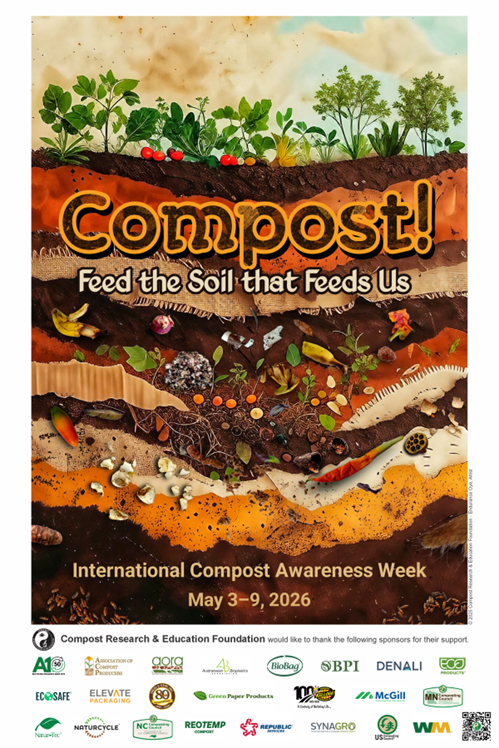
ECN celebrated this year’s International Compost Awareness Week (ICAW) through a range of activities, with a webinar (05/05) on the benefits of compost for long-term sustainable soil management in Europe as one of the key highlights.
|
|
|
|
|
The webinar explored the scale of bio-waste generated across Europe and what this means for compost production, particularly in relation to soil health and farm resilience under current agricultural stressors. It highlighted the significant potential of compost to support sustainable soil management, while also pointing to the existing gap in bio-waste collection and compost production.
|
|
Evidence presented showed that repeated annual compost application can contribute to long-term soil health and nutrient cycling, support farm economics, reduce dependency on mineral fertilisers, and make better use of locally available bio-waste resources and established EU-wide technologies.
|
|
The webinar recording can be accessed here, and the presentation is available here.
|
|
|
|
|
Further background information about this year’s ICAW theme ‘Compost! Feed the Soil that Feeds Us’ can be assessed on the website the International Compost Alliance of the here.
|
|
|
|
|
|
|
EU Bioeconomy Policy I 2026
|
The European Biotech Act II and the Future of Bio-Based Fertilisers
|
|
The forthcoming EU Biotech Act II, expected in late 2026, aims to strengthen Europe’s industrial biotechnology and bioeconomy sectors by accelerating the scale-up of bio-based products, biomanufacturing, and circular resource use. Building on the EU Bioeconomy Strategy and expected to align with broader EU funding priorities under the next Multiannual Financial Framework (MFF), the initiative could support investment in biorefineries, microbial technologies, organic amendments, bio-based fertilisers, and biowaste valorisation.
|
|
|
The Act is also linked to emerging EU initiatives such as the Circular Economy Act, the Soil Monitoring Law, and Horizon Europe bioeconomy programmes, all of which aim to improve nutrient recycling, strengthen the use of secondary raw materials, and reduce dependency on imported mineral fertilisers.
|
|
For the bio-based fertiliser sectors, the legislation may influence permitting frameworks, market conditions, and regulatory pathways for innovative products, while contributing to broader EU discussions on circularity and sustainability in agricultural systems across Europe.
|
|
|
|
|
Consultation on the upcoming Biotech Act II | Deadline 10 June 2026
|
|
The Commission is gathering input on the Biotech Act II, which follows on from the proposal for a Biotech Act I (that primarily covers the area of health biotech) and the Bioeconomy Strategy. The scope of the Biotech Act II is expected to be broader, covering industrial biotechnology and biomanufacturing, although the exact scope is not yet defined.
The overall aim is to reduce the use of fossil-based materials by replacing them with bio-based materials. The Act should propose measures to create lead markets for, among others, plastics and fertilisers. It will also seek to promote predictability for investment, develop sustainability criteria, and simplify EU legislation by speeding up permitting and tackling bottlenecks, including for fertilisers.
The public consultation is open until 10 June.
|
|
|
|
|
|
|
Bioeconomy | Study on the bioeconomy in agriculture
|
Publication of a study on the role of bioeconomy in agriculture
|
|
A study, prepared at the request of the European Parliament and published in April, examines how the bioeconomy can promote farms’ economic sustainability. It analyses policy frameworks, successful circular models in different European countries and trends in biomass valorisation, and provides policy options. The use of digestate, compost or other organic fertilisers is identified as a way to partially replace the purchase of mineral fertilisers and contribute to cost stabilisation. The study recommends investments in all bioeconomy-enabling infrastructures, including composting and digestate treatment.
|
|
|
|
|
|
|
European Soil Partnership Plenary Meeting I 30 April 2026
|
Developing a Voluntary Guideline for Sustainable Soil Management in Europe
|
|
|
|
The meeting explored how the guideline could better reflect Europe’s diverse regional soil conditions and farming systems while remaining practical and accessible for farmers, advisors, and policymakers. ECN also presented its new fact sheets demonstrating how compost application can contribute to long-term soil health and farm resilience.
|
|
|
|
|
|
|
EU Soil Monitoring I 2026
|
Supporting the “Test Your Soil for Free” Initiative Across Europe
|
|
|
|
The initiative encourages Member States to offer free soil testing to farmers and land managers as a tool to better understand soil health, improve management decisions, and support the transition toward more sustainable land use. While voluntary, it is considered an important step in achieving the EU vision of healthy soils by 2050.
|
|
Soil testing is highlighted as a key entry point for improving nutrient management, identifying soil degradation risks, and guiding the use of sustainable practices such as organic amendments, compost application, and bio-based fertilisers. The report also stresses that better soil data and monitoring are essential to support climate goals, biodiversity protection, and circular economy objectives.
|
|
|
|
|
|
|
IFAT Munich 2026 | Trade fair for environmental technology
|
ECN join panel discussion on waste management as a driver of climate protection
|
|
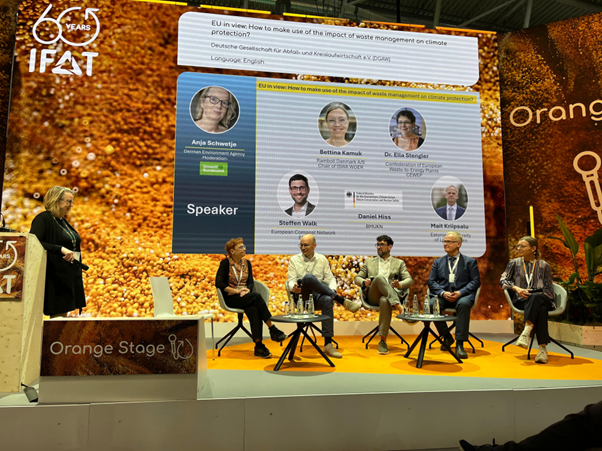
The world’s leading trade fair for environmental technology, including waste management, took place from 4-7 May 2026. In addition to exhibitors from around the world, the programme featured workshops, demonstrations, expert presentations and panel discussions.
|
|
This year, ECN contributed to the panel discussion “EU in view: How to make use of the impact of waste management on climate protection?”, hosted by Anja Schwetje of the German Environment Agency and organised by the German Society for Waste Management (DGAW).
|
|
Steffen Walk, ECN’s Scientific Officer, stressed that biowaste must be treated as a strategic resource stream for the overall bioeconomy, climate mitigation, soil restoration and nutrient recycling. Currently, the biggest missed opportunity is the loss of biowaste from the circular economy through poor capture, and weak market update of products.
|
|
|
|
|
|
|
|
Public consultation | Deadline 29 May 2026
|
Consultation open on the Industrial Accelerator Act
|
|
|
|
The Industrial Accelerator Act presented by the Commission in March aims to increase demand for low-carbon, European-made technologies and products. It contains measures to create industrial manufacturing acceleration areas with faster permit procedures and it introduces Union origin and low-carbon requirements in public procurement. While the proposal will now be discussed at the Parliament and the Council, the Commission opened a consultation until 29 May.
|
|
Link to the consultation.
|
|
|
|
|
|
|
Public consultation | Deadline 29 July 2026
|
Consultation on the future Critical Raw Materials Centre
|
|
The Commission is planning to set up an EU Critical Raw Materials Centre consisting of 4 strands: access to investment for CRM projects, joint purchasing to support the European companies on global markets, stockpiling to limit supply disruptions, and increase market intelligence on CRM. The main objective is to contribute to the secure and sustainable supply of CRMs to support the transition and strengthen EU’s resilience.
|
|
|
|
|
|
|
European Commission | Packaging and Packaging Waste Regulation
|
Study on the support for bio-based feedstock in plastic packaging
|
|
A study on the development of bio-based plastics, carried out at the request of the Commission, was published in April. The report assesses the role of bio-based feedstocks in plastic packaging under the Packaging and Packaging Waste Regulation. Indeed, the Regulation provides that the Commission should review the state of development and environmental performance of these materials, with a view to proposing sustainability requirements, setting targets to increase their use, and introducing the possibility that bio-based content could contribute to the recycled content targets set in the Regulation. The main recommendations of the study are to set binding targets for bio-based content in packaging, linked to harmonised sustainability criteria, to recognise the equivalence between recycled and bio-based carbon content, and to support infrastructure development for the collection and recycling of bio-based plastics.
|
|
|
|
|
|
|
European Economic and Social Committee | Biodegradable materials
|
Publication of the opinion of the EESC on biodegradable materials
|
|
In its opinion on nature-based biodegradable materials adopted on 29 April, the European Economic and Social Committee highlights the opportunity of the EU to accelerate the transition towards a circular bioeconomy. It stresses that efficient use of resources requires applying the waste hierarchy, prioritising prevention, reuse and material efficiency, and emphasises the potential of nature-based biodegradable materials to reduce pollution, support regional economies and strengthen EU competitiveness while calling for greater regulatory coherence.
|
|
|
|
|
|
|
|
|
ECN Annual meeting I 8 June 2026 I 12:00 to 18:00 h I Brussels
|
Compost and Digestate in the EU Circular Bioeconomy
|
This year, the ECN Annual Meeting will be held in Brussels on 8 June 2026.
We are pleased to announce that Ms Mirabella Lupaescu from the Directorate-General for Environment will be our keynote speaker. Her presentation on the EU bioeconomy strategy will be complemented by key findings from long-term trials on the use of compost for soil health, presented by Olivier Labrie, ECN’s project officer for agriculture.
Interested stakeholders can join the public session by contacting the ECN office at infro@compostnetwork.info.
|
|
|
|
|
|
|
ECN TG QA Meeting I 8 July 2026
|
Risk management and monitoring approaches in quality assurance schemes for compost & digestate
|
|
An internal ECN member meeting of the TG Quality Assurance will take place on 8 July 2026 from 09:00 to 12:30. Members interested in joining this task group to discuss ongoing activities related to risk assessment and monitoring approaches in quality assurance schemes for compost and digestate are welcome to join. Please contact the ECN office at info@compostnetwork.info.
|
|
|
|
|
|
Announcements
|
|
|
|
Global Symposium on Soil Compaction I 21–23 September 2026
|
Soil Compaction: Impacts, Monitoring and Solutions
|
|
Soil compaction is one of the most widespread forms of land degradation and affects cropland, grasslands, and forests worldwide. The symposium will bring together researchers, policymakers, and practitioners to share evidence on its impacts on soil structure, crop productivity, water movement, and ecosystem services, as well as on climate resilience.
|
|
Across three days, participants will discuss how compaction can be assessed, monitored, and reduced through better machinery practices, land management, and policy approaches. The programme will also focus on barriers to implementation and how scientific knowledge can be translated into practical solutions for farmers and land managers.
|
|
Abstracts can be submitted until 30 April 2026. Participation is free of charge, with both in-person and online attendance available.
|
|
|
|
|
|
|
|
|
|
|
Registration open I 8 June 2026
|
Open Platform on Biowaste 2026
|
|
The “Open Platform on Biowaste 2026” conference takes place in Stuttgart. This event is jointly organized by the Baden-Württemberg Ministry of the Environment, Climate, and Energy and the Baden-Württemberg State Agency for the Environment (LUBW). The aim of the event is to promote dialogue on challenges and solutions in the field of biowaste recycling and to identify ways to improve the circular economy through the exchange of information, experiences, and ideas among experts from industry, research, and politics. The conference will be held in German.
|
|
You can register here: LINK
|
|
|
|
|
|
|
Save the Date I 9 November 2026
|
Sustainable Substrate Day
|
Would you like to know more about research into cultivation substrates in various horticultural crops? Come to the Sustainable Substrates Day!
When: November 9, 2026
Where: VAC Ghent (at Ghent Sint-Pieters station, 1 p.m. to 5 p.m.)
More info will follow!
|
|
|
|
|
|
|
Registration open I 11-12 November 2026
|
3rd Austrian Compost Congress
|
|
The Austrian Compost and Biogas Association is organizing the 3rd Austrian Compost Congress from November 11th to 12th, 2026, at the Francisco Josephinum in Wieselburg.
|
This year, you can once again expect interesting lectures and discussions. Well-known exhibitors from the composting sector will be present! 250 visitors are expected.
Key topics of the event will include:
|
- What are the latest developments in laws and standards in the composting sector?
- What are the key issues in the industry?
- Compost vs. composted soils vs. growing media
- What is the value of compost? (Practical reports)
- Technology presentations
|
Join us and register here. Further information can be found at: LINK
|
|
|
|
|
|
S.O.S Save Organics in Soil
|
This international initiative S.O.S. SOIL – Save Organics in Soil, led by the European Compost Network (ECN) and the Italian Composting and Biogas Association (CIC), aims to highlight the importance of soil organic matter to encourage policy makers to develop instruments to move Europe towards implementing sustainable, climate proof soil management practices.
|
|
Sign the manifesto 'Save Organigs in Soil' here.
|
|
|
|
|
|
|
|
|
|
ECN-QAS Trade Mark No 011007168
Trade mark for certified quality assurance
organisations, compost and digestate products
according to ECN-QAS
Website: www.ecn-qas.eu
|
|
|
|
|
|