
Result Summary: This fact sheet examines how biowaste collection mode and use control influence biowaste separation performance and the quality of separately collected biowaste. Door-to-door (DtD) collection achieves the highest separation rates and the lowest impurity levels, while bring point (BP) collection performs weakest. Use control further improves performance, particularly in BP collection, where smart containers with individual user identification are associated with higher separation rates and lower impurity levels.
Introduction
The collection mode describes how waste is collected from households. BP collection requires residents to bring their waste to shared containers, while DtD collection collects waste directly at or near the households. In Catalonia, some municipalities also combine both modes into a mixed collection. However, households are usually assigned to either DtD or BP collection. The collection mode therefore influences the proximity, convenience and individual character of the system. DtD collection usually provides a closer link between the household and the collected waste, especially through the use of individual bins. This fact sheet specifically focuses on the collection mode of biowaste.
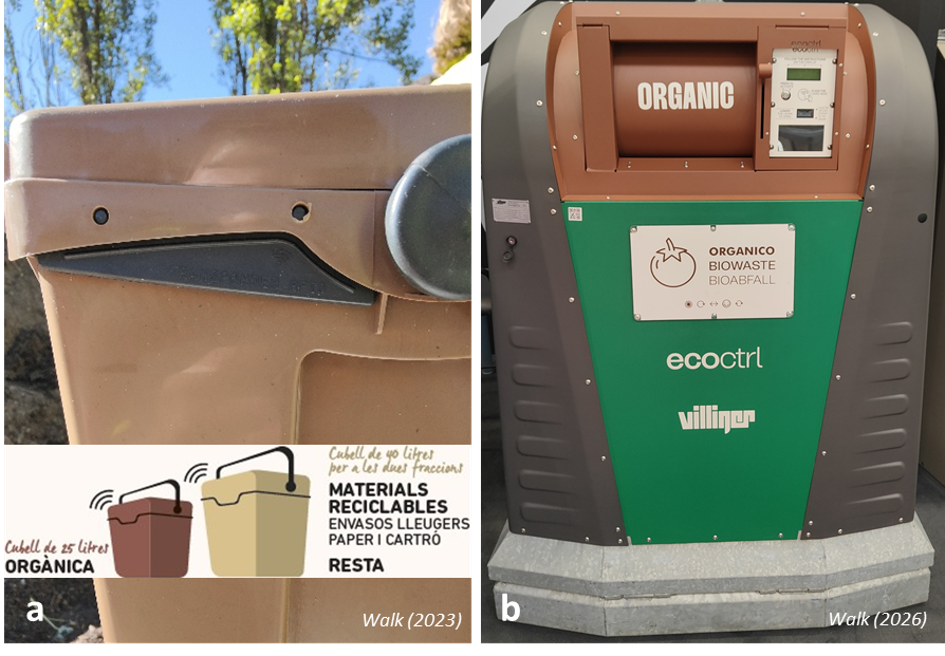
Use control describes whether the use of the collection system by a specific household is tracked by the waste management authority. In DtD collection, this can be done through RFID-chipped bins, bags or receptacles (Figure 1a). In this fact sheet, use control in DtD systems was classified based on the presence of chipped collection equipment. In BP collection, user identification is usually based on controlled-access containers (smart containers, Figure 1b) that can be opened with a card, chip or mobile application. Such systems may only record use, but they can also restrict access, for example by limiting the use of waste containers to specific weekdays.
Use and access control can support monitoring of participation and separation behaviour. They also provide the technical basis for feedback, rewarding good separation performance, addressing incorrect use and introducing pay-as-you-throw (PAYT), where waste charges are linked directly to the use of the collection service.
Info: Terminologies are explained in the sections on Key Performance Indicators (KPI), Influencing Factors (IF) and Glossary on the project website: Link
Descriptive overview
Influencing factor overview
Four collection modes are applied for biowaste collection in Catalonia. Bring point (BP) collection is the dominant mode, covering 57% of the population (499 collection areas). Door-to-door (DtD) collection is used as the only collection mode in 263 areas, covering 9% of the population. 69 areas, representing 34% of the population, are covered by mixed DtD and BP collection. In these areas, the two systems operate in parallel within the same collection area, but individual households are assigned to either DtD or BP collection. In addition, eight small municipalities were identified where community composting is used as sole biowaste management concept. No separate biowaste collection was identified for 1% of the population (108 collection areas). With the exception of areas with community composting or no separate biowaste collection, the collection mode for biowaste mostly corresponds to the collection mode for residual waste.
Compared with 2020, the distribution of collection modes indicates a shift towards more DtD collection. In 2020, BP collection covered 88% of the population, while DtD collection and mixed collection covered only 4% and 6%. The share without separate collection was 2%.
Infobox: Connection rate to DtD collection in mixed areas
For mixed DtD and BP collection areas, the available data includes the share of the population connected to DtD collection. The mean share is 52 ± 35% (median = 62%), with a range from 1% to 97%. However, the population-weighted mean is only 7% of the population, indicating that larger cities with mixed areas often have a relatively small share of residents connected to DtD collection.
The remaining population in mixed areas is assumed to be served by BP collection.
After allocating the population in mixed areas according to the DtD connection rate, BP collection covers 88% of the population, DtD collection covers 11%, and the share without separate biowaste collection remains at 1%.
Use control is more common in areas with DtD collection than in areas with BP collection. Where it is applied in Catalonia, it generally applies to both biowaste and residual waste. In DtD collection areas, use control is applied to 85% of the population (235 collection areas). It is not applied to 13% (64 areas), while no information was found for 33 collection areas (2% of population).
In BP collection areas, use control is applied to 7% of the population (107 areas), while most BP areas operate without identified use control (93% of the population, 436 areas). No information was found for 25 collection areas (1% of the population).
Where use control is applied in BP systems, it is usually linked to controlled-access containers. In some cases, this goes beyond user identification and includes access restrictions, for example by limiting the use of residual waste containers to specific weekdays.
Spatial distribution
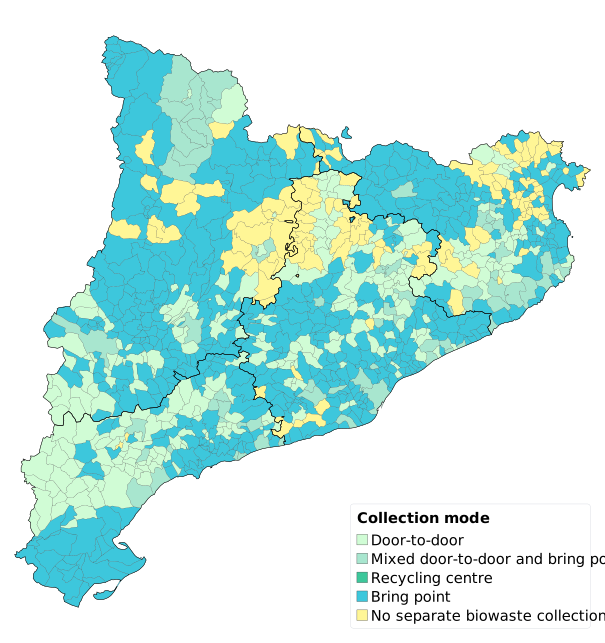
The spatial distribution shows that bring point collection is the dominant collection mode across Catalonia (Figure 2). DtD and are geographically clustered, particularly in the south-west, the north and the north-east.
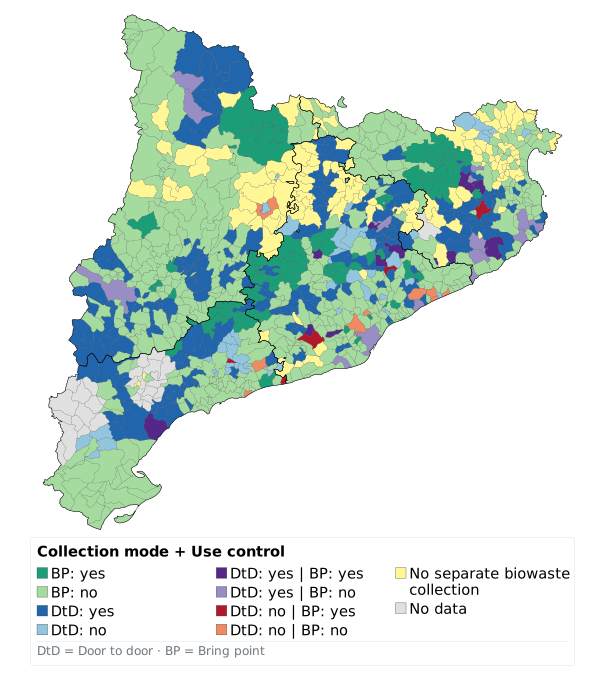
Use control in BP collection is mainly clustered in central and northern parts of Catalonia. In DtD collection areas, use control broadly follows the spatial distribution of DtD collection.
Statistical Assessment
The biowaste stream separation rate (SRBW,gross) and impurities in separately collected biowaste (BWImp) were used as the key performance indicator (KPI) for the statistical assessment. Additional figures showing the influence of the assessed influencing factors on biowaste and residual waste quantities are provided in the appendix (Download Factsheet PDF).
The first part of the assessment evaluates differences between the biowaste collection modes. The boxplots in Figure 4 indicate a clear gradient in SRBW,gross between DtD, Mixed and BP collection.
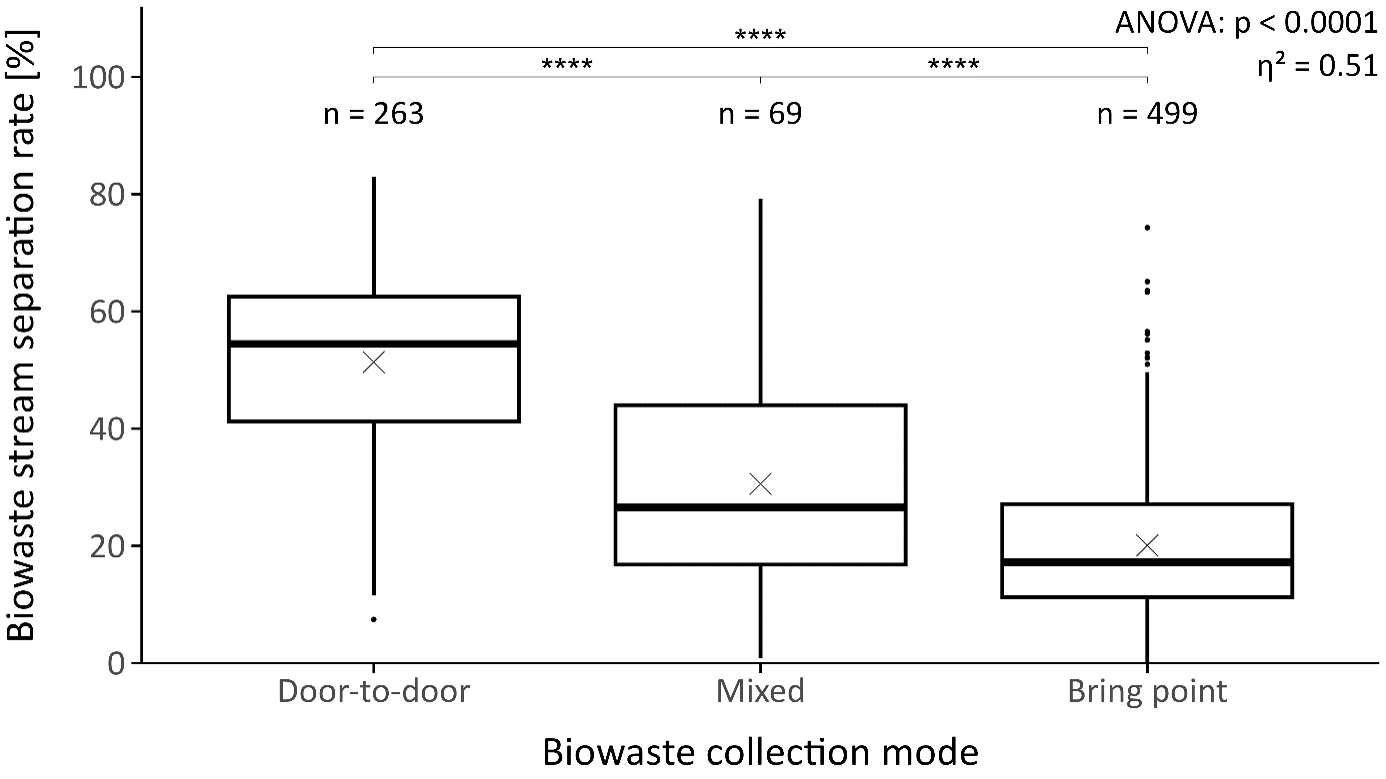
DtD collection shows the highest SRBW,gross, with a median of 54%, compared with 27% for mixed systems and 17% for BP collection.
A similar but inverse pattern is observed for BWImp (Figure 5).
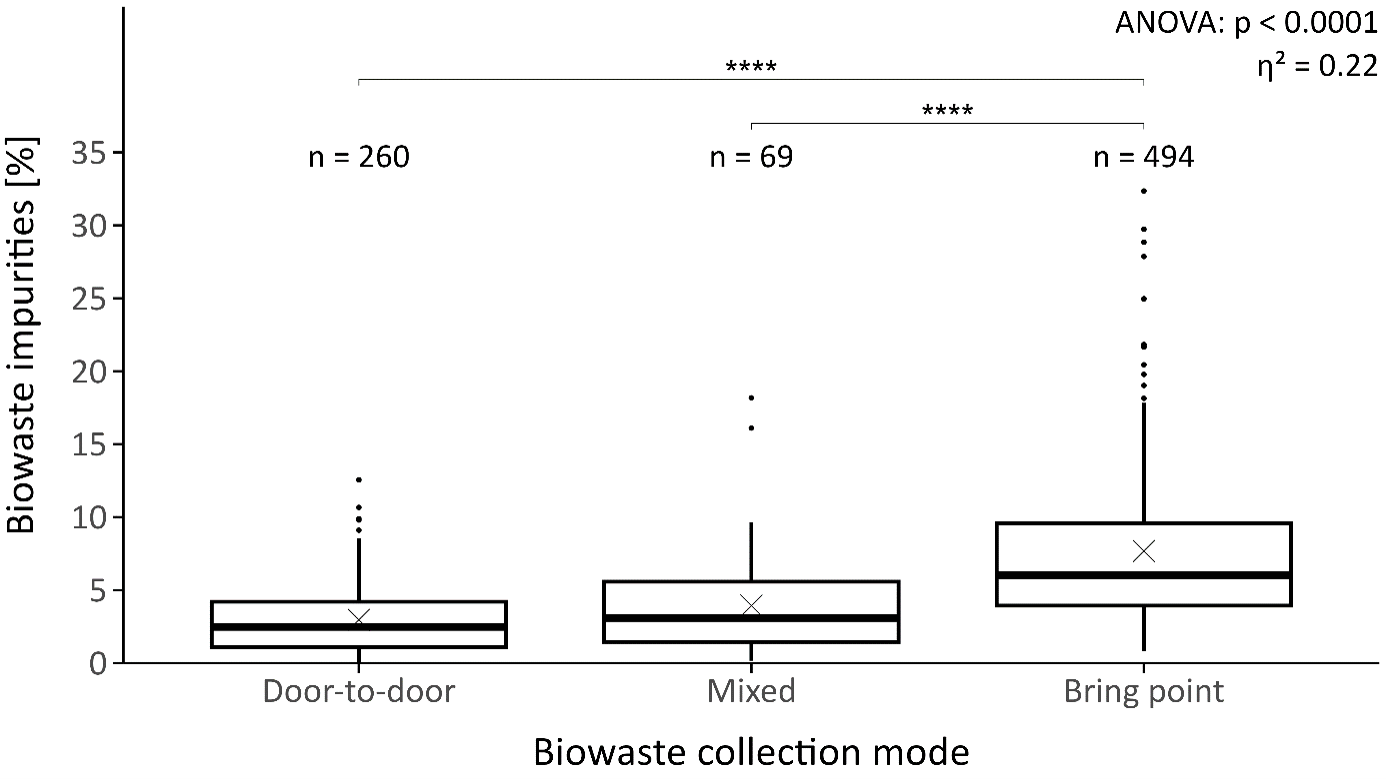
DtD collection shows the lowest impurity levels, with a median BWImp of 2.5%, followed by Mixed collection at 3.1%. BP collection has considerably higher impurity levels, with a median of 6.0%. The results therefore indicate that collection modes associated with higher biowaste separation rates also tend to produce cleaner separately collected biowaste.
The second part of the assessment evaluates use control in combination with the biowaste collection mode. To keep the comparison clearly interpretable, only areas using either DtD or BP collection were included. Figure 6 shows clear differences in SRBW,gross between systems with and without use control.
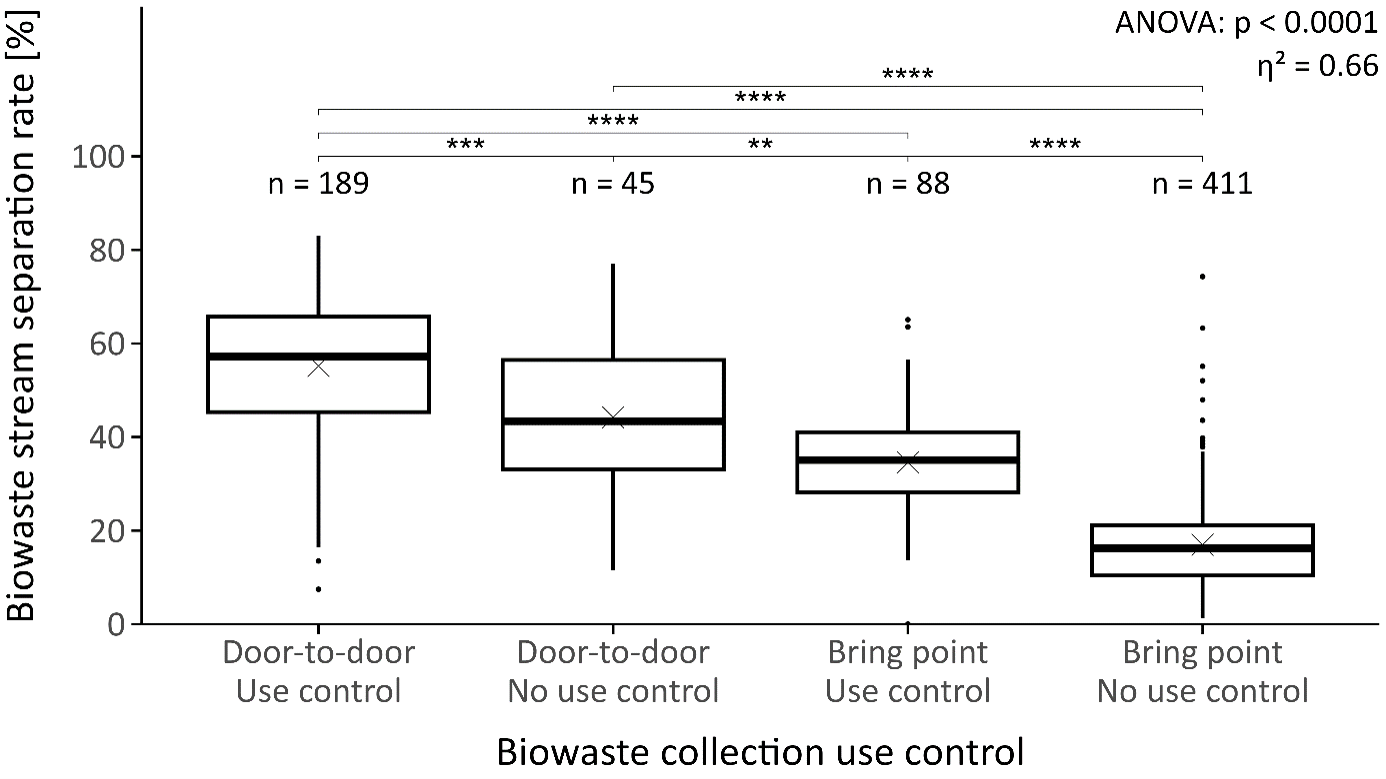
For both collection modes, use control is associated with higher separation rates. For DtD collection, the median SRBW,gross increases from 43% without use control to 57% with use control. The difference is even larger for BP collection, where the median increases from 16% to 35% with access control. Nevertheless, DtD collection without use control still shows a higher median separation rate than BP collection with access control.
For BWImp, the overall pattern is reversed, with lower impurity levels generally associated with use control (Figure 7).
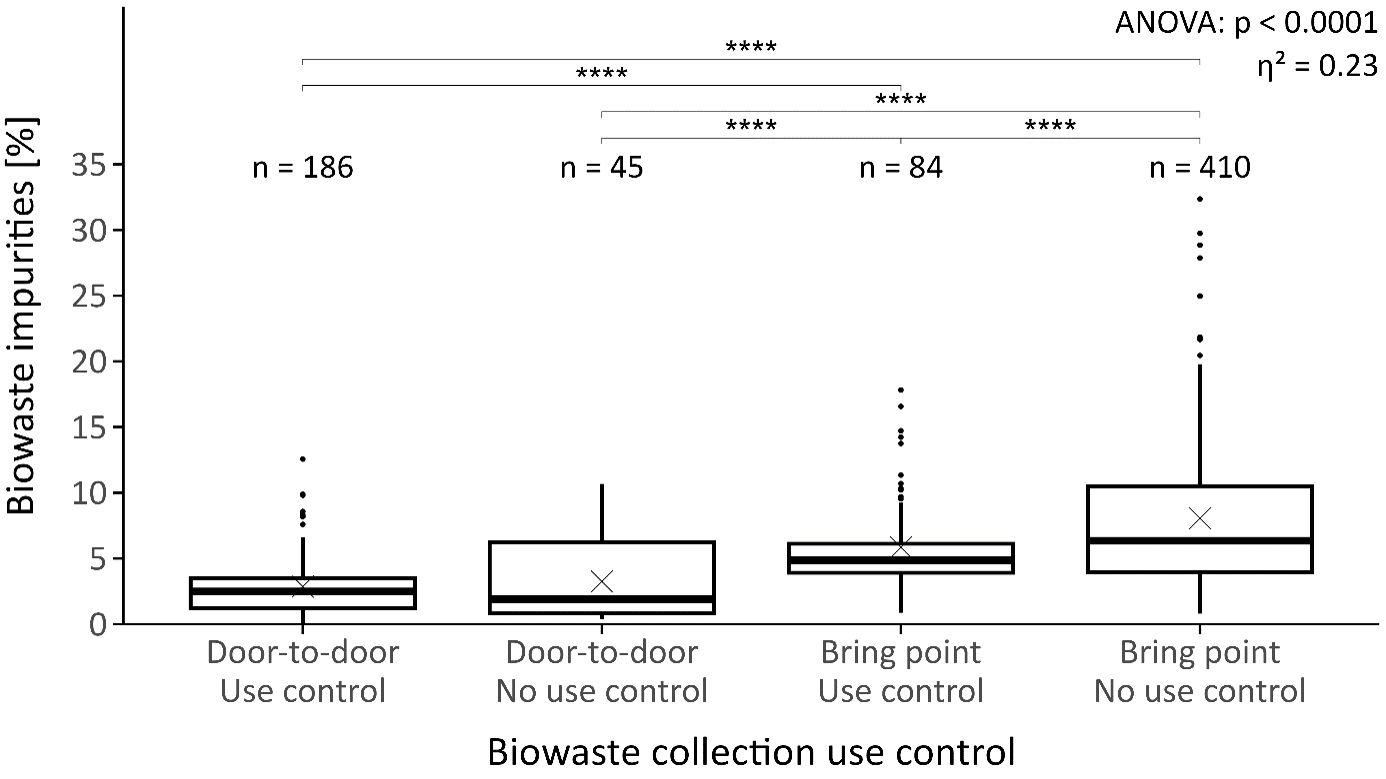
For BP collection, the median BWImp decreases from 6.4% without access control to 4.9% with access control. For DtD collection, median impurity levels are similarly low with and without use control (2.5% and 1.9%, respectively). The mean values show the opposite direction, however, with slightly lower impurities for DtD collection with use control (2.9% compared with 3.2%). This indicates greater variability and less distinct relationship between use control and BWImp within DtD systems than for BP collection.
Significance testing
The biowaste collection mode had a statistically highly significant effect on both SRBW,gross and BWImp (p < 0.001). For the separation rate, all pairwise comparisons were significant, with the highest values for DtD collection, followed by Mixed and BP collection. For the impurities, BP collection differed significantly from both DtD and Mixed (p < 0.001), while the difference between DtD and Mixed was not statistically significant.
The use control, in combination with the biowaste collection mode, also showed statistically highly significant differences for both KPIs (p < 0.001). For SRBW,gross, the results show a clear gradient from DtD collection with use control towards BP collection without use control. For BWImp, all comparisons were statistically significant except between DtD collection with and without use control. BP collection, with an without use control, had significantly higher impurity levels than DtD collection, while access-controlled systems performed better than those without.
Effect size
The biowaste collection mode had a large effect on both KPIs. For SRBW,gross, 51% of the observed variation can be associated with the collection mode. The effect on BWImp was smaller but still large, accounting for around 22% of the observed variation.
Use control in combination with the collection mode showed an even stronger effect for the separation rate. Around two thirds of the observed variation can therefore be associated with the combined collection mode and control configuration. A large effect was also found for BWImp, accounting for 23% of the observed variation. These results support the assumption that both the collection mode and the presence of use control are highly important factors associated with biowaste collection performance.
Conclusion
The results show a clear association between collection mode and the biowaste separation performance and quality of collected material. DtD collection achieves substantially higher SRBW,gross and lower BWImp than BP collection, while mixed collection generally show intermediate results. The statistical analysis confirms large effects for both KPIs. However, collection mode is also related to settlement structure as DtD collection is more common in smaller municipalities, whereas larger municipalities more frequently rely on BP or mixed systems.
Use control appears to provide an additional opportunity to improve performance. Separation rates are significantly higher with control for both DtD and BP collection. In BP collection, use control is also associated with significantly lower impurity levels, indicating that smart containers with individual user identification can improve performance compared with anonymously accessible BP containers. Nevertheless, DtD without use control still performs better than access-controlled BP collection, showing that control can reduce, but not fully eliminate, the performance differences between the collection modes.
For DtD collection, the relationship between use control and biowaste impurities is less clear. One possible explanation is that the 2024 data partly reflect the presence of chipped bins rather than active monitoring or pay-as-you-throw (PAYT), as several municipalities introduced RFID-equipped bins in preparation for later PAYT systems before or in 2024, while use control was planned to start after 2024. For BP systems, user identification through smart containers directly controls access and may also include restrictions on use, which could explain the clearer association with both separation rate and impurity levels.
A further limitation to be considered when interpreting the results is the basis of impurity measurements. These were partly available at collection-circuit rather than municipality level and therefore had to be assigned or aggregated to municipalities using the available information and collected masses.
Despite these limitations, the overall pattern is consistent. DtD collection provides the strongest basis for high biowaste separation performance and low impurity levels, especially when combined with use control. Where DtD collection is difficult to implement, particularly in denser urban areas, access-controlled BP systems represent an important improvement compared with conventional open BP collection. However, where feasible, DtD collection with use control should remain the preferred option.