

Result Summary: This fact sheet examines the impact of collection container configuration (optical bag sorting, four-compartment bins, two-compartment bins, separate bins) on food waste separation performance, using the collection system in Sweden as an example. While separate bins are mainly used among Swedish municipalities, four-compartment bins achieve the best results in separate collection of biowaste.
Introduction
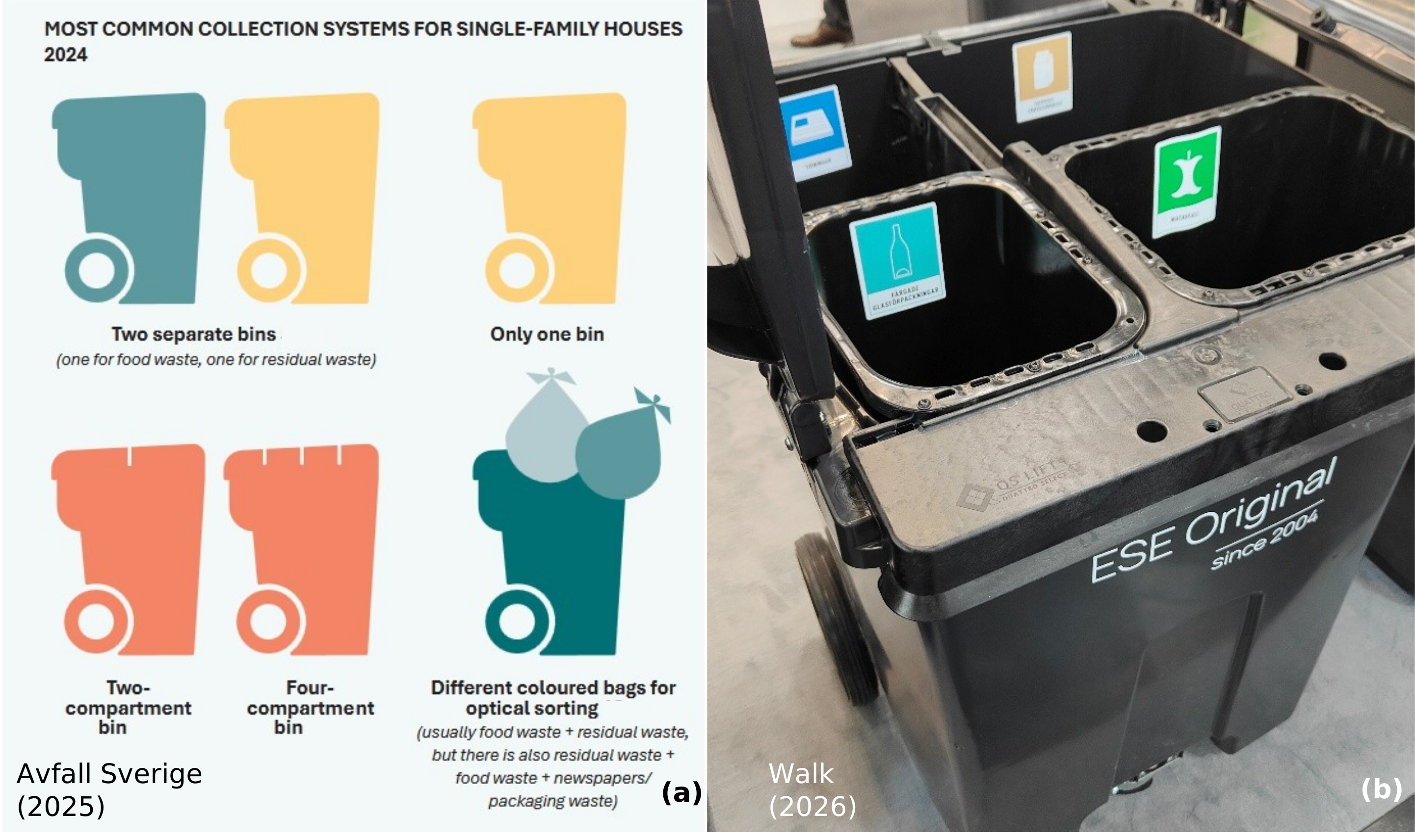
Collection container configuration refers to the type of arrangement of household waste collection containers. This assessment focusses on the collection of food waste and residual waste. It describes whether these waste fractions are collected in separate bins, in multi-compartment bins (two or four compartments), or in a single bin using colour-coded bags for optical sorting.
Even in multi-compartment system arrangements, food waste and residual waste may be collected either within the same or in separate containers, depending on whether one or two multi-compartment bins are provided for multiple fractions in the respective municipality.
The separate bin arrangement refers to systems in which food waste and residual waste are collected in separate single compartment containers. Depending on the overall collection system and the waste fractions collected separately, households may be provided with varying numbers of bins.
In the optical sorting arrangement, different waste categories are placed separately in different colour-coded bags and collected in the same one compartment container. They are separated at the waste facility using optical sensors.
Info: Terminologies are explained in the sections on Key Performance Indicators (KPI), Influencing Factors (IF) and Glossary on the project website: Link
Descriptive overview
Influencing factor overview
Most of the population with separate food waste collection is served by a separate-bin configuration (62.7%, 133 collection areas). Four-compartment bins account for 23.5% of the population (64 areas), optical bag sorting for 10.3% (29 areas), and two-compartment bins for 3.6% (19 areas).
Spatial distribution
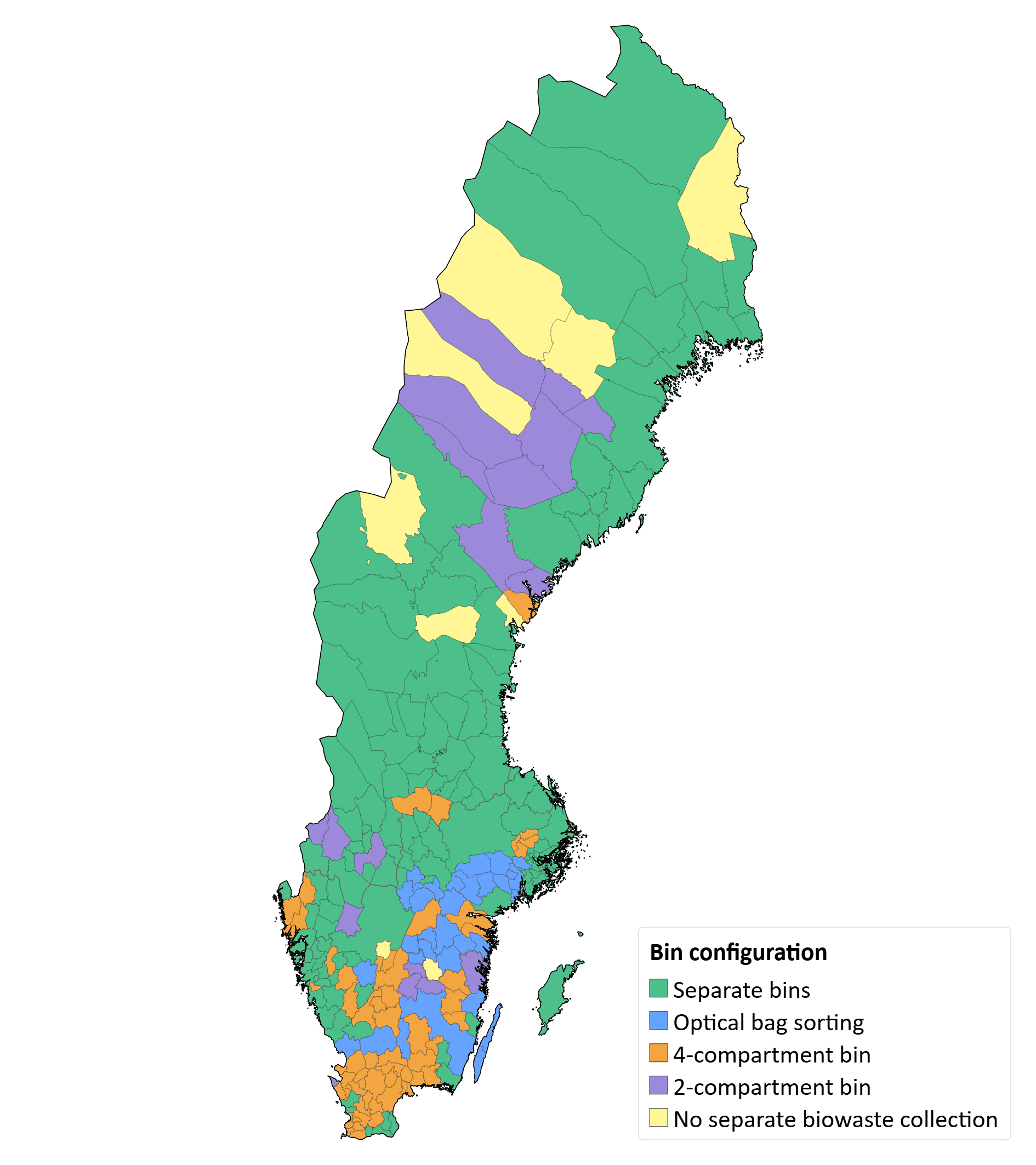
Separate bins are distributed across the country, while four compartment bins and optical bag sorting only occur in the south of Sweden (Figure 2).
Statistical Assessment
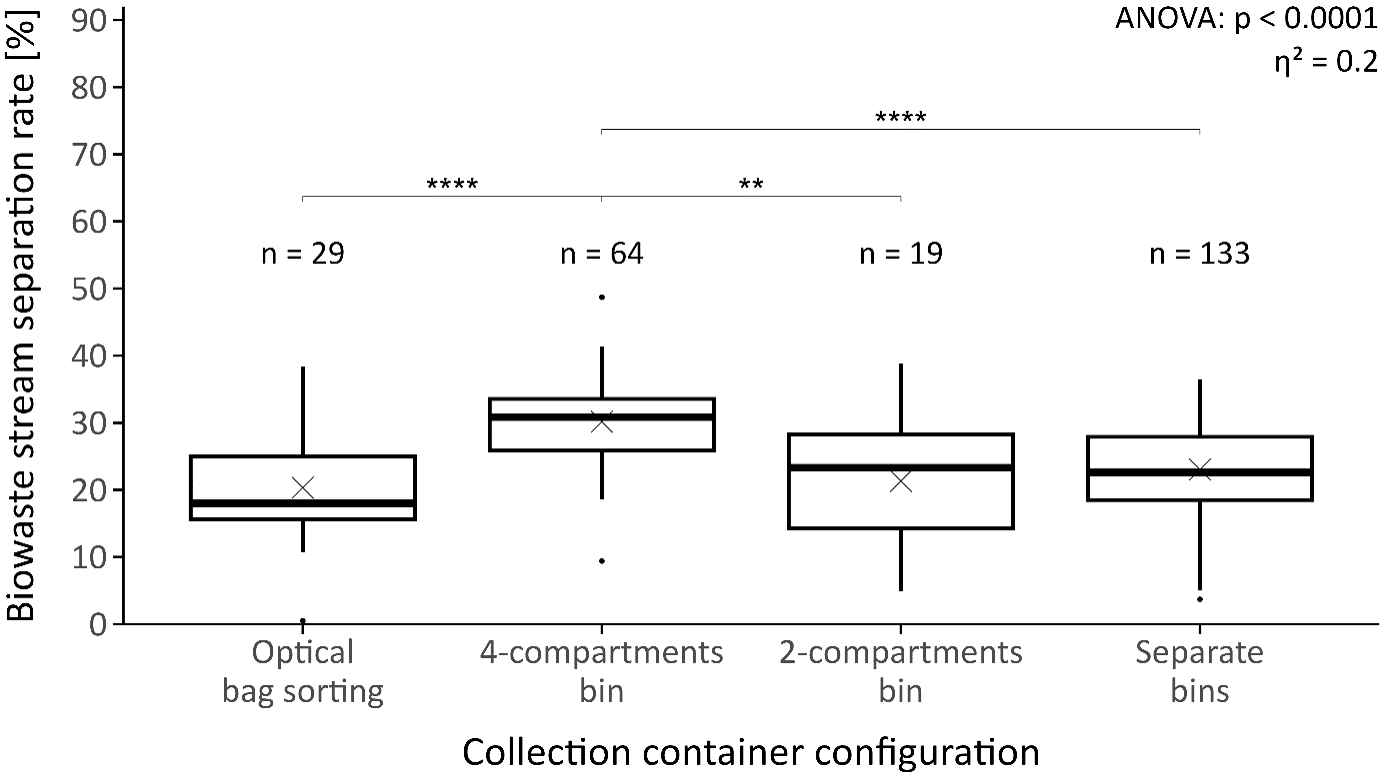
The biowaste stream separation rate (SRBW,gross) was used as key performance indicator (KPI). The boxplots in Figure 3 show differences in SRBW,gross between collection areas with different collection container configurations. Figures showing the influence of the assessed influencing factor on biowaste and residual waste quantities are provided in the appendix (Download PDF).
Among the four configurations, four-compartment bins show the highest SRBW,gross values overall, with a median of 31% and a relatively narrow interquartile range (Q1 = 26%; Q3 = 34%). Separate bins and two-compartment bins show intermediate values, both with a median of 23%, although two-compartment bins display greater variability. Optical bag sorting shows the lowest SRBW,gross values, with a median of 18% and the lowest lower quartile (Q1 = 16%).
Significance testing
The statistical analysis indicates that SRBW,gross differed between collection container configurations (significant ANOVA, p < 0.05). Pairwise comparisons further suggest that these differences are mainly driven by the performance of four-compartment bins, which differed significantly from all other configurations. By contrast, no significant pairwise differences were found between the other configurations.
Effect size
The effect size using eta-squared (η²) resulted in a value of η² = 0.2. This suggests that approximately 20% of the observed variation in SRBW,gross values can be associated with the collection container configuration. This can be interpreted as a large effect, indicating that the type of container configuration is likely to be an important factor influencing the separate collection of food waste.
Conclusion
The statistical results indicate that collection container configuration is a relevant influencing factor for food waste separation performance. Among the assessed categories, four-compartment bins show the most favourable results and significantly outperform the other systems. This underlines that container design should be considered carefully when selecting locally suitable best-practice solutions.
There are several possible explanations that could explain the results. Separate-bin systems offer greater flexibility for designing frequencies, bin sizes, tariffs and other influencing factors by waste stream, while compartment systems can improve collection efficiency, especially in low-density areas. Optical sorting reduces the number of bins but may entail quality risks linked to plastic bags in the food waste stream, misunderstanding of the sorting concept by residents, and reduced sorting quality if bags tear during collection or handling.