Introduction
| Reference year | 2024 |
| Population (-) | 8,034,743 |
| Population density (inhabitants per km2) | 250 |
| Number of distinct collection areas (-) | 947 |
| Number of collection organisers (-) | 313 |
| Amount of separately collected organics streams (t per year): | 574,045 |
| ↳ Thereof biowaste waste stream (t per year) | 457,222 |
| ↳ Thereof green waste stream (t per year) | 116,823 |
| Amount of collected residual waste (t per year) | 2,044,066 |
| Total organics streams separation rate (%) | 22 |
| Biowaste stream separation rate (%) | 18 |
| Net biowaste separation rate (%) | 47 |
| Biowaste recycling rate (%) | - |
| Total recycling rate (%) | 49 |
Note: Key Performance Indicators and Influencing Factors are defined on the project website: Link
Waste collection organisation in Catalonia
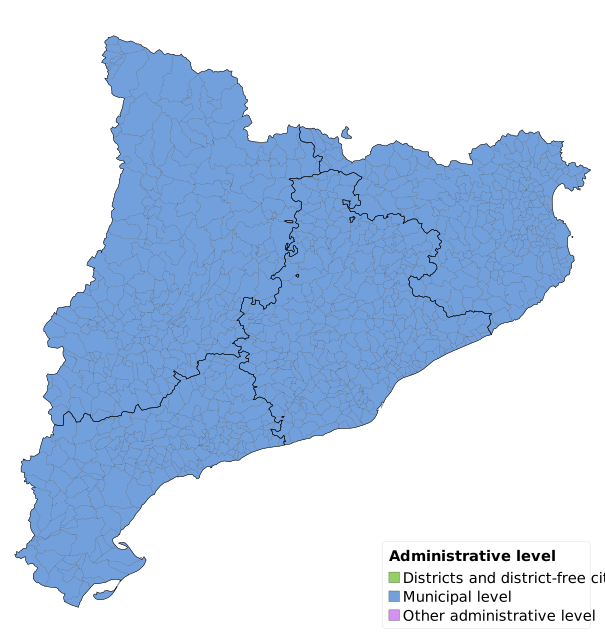
Waste collection in Catalonia (CAT) is performed at municipal level (Figure 1). Catalonia comprises 947 municipalities. In practice collection is not always implemented by each municipality individually. Several municipalities cooperate through supra-municipal organisation (e.g. Mancomunitat) while collection services may also group municipalities into operational collection circuits (see Infobox 2).
Biowaste stream quantities
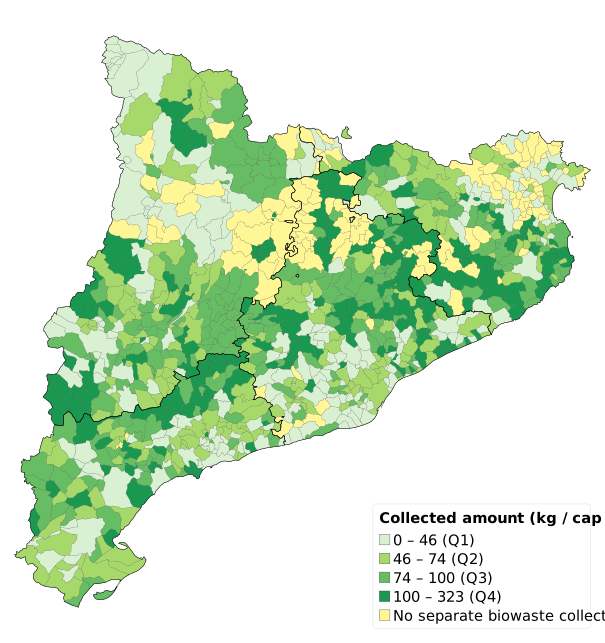
The mean quantity of separately collected biowaste was 76 ± 42 kg per inhabitant and year (median = 73), with a minimum of 0, and a maximum of 323 (Figure 2).
Infobox 1: Separate collection of biowaste in Catalonia
Separate collection of biowaste, referred to as FORM (Fracció Orgànica dels Residus Municipals), started in 1996. The focus is laid on a single-stream food waste collection. The system is coordinated by the Catalan Waste Agency (Agència de Residus de Catalunya, ARC), which is responsible for waste generated and managed within Catalonia and provides regional monitoring, statistics, planning and guidance (ARC 2026).
All municipalities are quired to organise separate collection or alternative management of biowaste, including home or community composting, particularly in rural or dispersed areas. Municipalities and supra-municipal entities may choose different collection models, such as door-to-door collection or street containers.
A key feature of the Catalan system is the landfill and incineration tax, combined with a refund mechanism for local authorities. This system penalises disposal of residual waste while returning funds to municipalities for separate collection and treatment (ARC 2024).
The quality of FORM is monitored through regular waste characterisations of all collection circuits (up to 4 times per year). The characterisations determine the share and type of impurities and are used to calculate net FORM quantities and quality coefficients for the refund system (ARC 2015).
Residual waste stream quantities
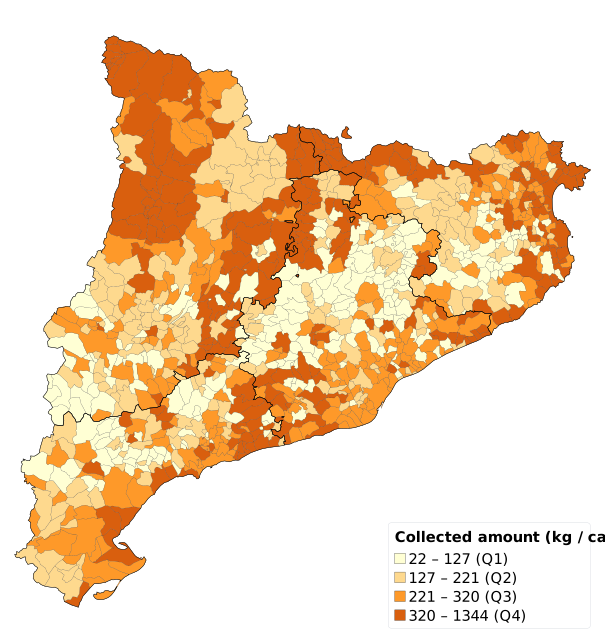
The mean quantity of collected residual waste was 246 ± 161 kg per inhabitant and year (median = 221), with a minimum of 22, and a maximum of 1344 (Figure 3).
Biowaste stream separation rate
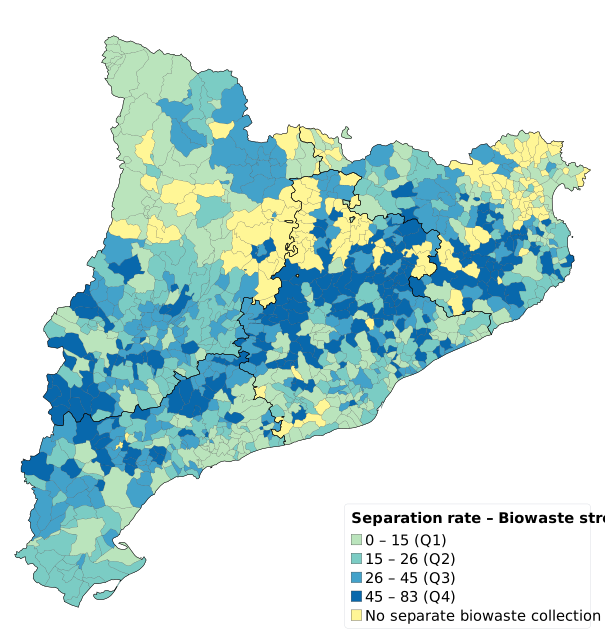
The biowaste stream separation rate (SRBW,gross) indicates for most collection areas a residual bin dominant collection Figure 4. However, a strip of municipalities (179 = 7.5% of the population), stretching from north-east to south-west, largely collect a larger share of waste via the biowaste bin compared to the residual waste bin (SR ≥ 50%). The mean SRBW,gross was 31 ± 20% (median = 25%), with a minimum of 0%, and a maximum of 83%.
Impurities in the biobin
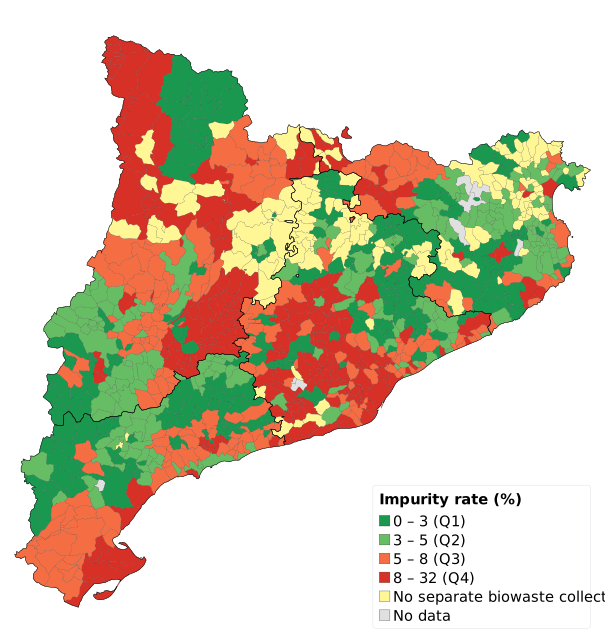
The mean share of impurities in biowaste was 5.9 ± 4.8 % (median = 4.6), with a minimum of 0.1, and a maximum of 32.4 (Figure 5).
Infobox 2: Waste characterisation of FORM in Catalonia
The quality of separately collected biowaste (FORM) in Catalonia is assessed through regular waste characterisations, following a standardised method provided by the Catalan Waste Agency. These analyses determine the share and composition of impurities in the collected FORM and therefore provide an important basis for monitoring collection quality, calculating net FORM quantities and informing financial incentives linked to the refund mechanism.
The characterisations are not necessarily carried out separately for each municipality. Instead, they may be assigned to operational collection circuits, which can include several municipalities that are collected and treated together. As a result, the same impurity value can apply to more than one municipality within the same circuit. This is visible, for example, in spatial clusters of neighbouring municipalities with identical values in Figure 5.
The dataset was provided by the Separate Collection Department of the Catalan Waste Agency, including collection-circuit-specific information and quantities. The data was then further processed and aligned with the municipal collection structure in Catalonia.
Associated Fact Sheets
→ Click on the tiles to read or download the full factsheet