
Result Summary: This fact sheet examines the effects of participation policy and the population connection rate to door-to-door biowaste collection on biowaste separation performance with North Rhine-Westphalia, Germany, as a case study.
Mandatory participation applies in most collection areas, while voluntary schemes are concentrated mainly in densely populated cities. Mandatory schemes achieve higher connection rates, which are associated with higher biowaste stream separation rates. However, mandatory participation should only be combined with controlled exemptions, as home composting does not necessarily prevent biowaste, especially kitchen waste, from remaining in the residual waste stream. A smaller biobin or reduced minimum bin volume could provide a balanced approach for households practising home composting.
Introduction
The participation policy is implemented by local waste authorities. It defines whether participation in biowaste separate collection is mandatory or a voluntary. However, residents may be exempt even in mandatory schemes if they can demonstrate proper and environmentally sound home composting, as outlined in the municipal waste statutes in accordance with Section 7 (3) of the German Circular Economy Act (KrWG). Exempted households are considered not connected to the collection service.
The population connection rate estimates the share of residents within a defined area that are formally assigned to the separate biowaste collection service. Assignment may be active, where residents subscribe to the service, or passive, where a biowaste bin is provided without prior registration. For door-to-door (DtD) collection, the connection rate is expected to be similar to the actual participation rate, although this may as well depend on the implementation structure. In this case study, the connection rate is assessed only for DtD collection, as connection and participation in bring schemes are difficult to determine and enforce, particularly in unsupervised schemes.
Info: Terminologies are explained in the sections on Key Performance Indicators (KPI), Influencing Factors (IF) and Glossary on the project website: Link
Descriptive overview
Influencing factor overview
Participation policies are almost evenly distributed across NRW’s population. Mandatory participation in separate biowaste collection applies to 53% of the population, covering 285 collection areas. The remaining 47% of the population, covering 70 collection areas, are offered separate biowaste collection on a fully voluntary basis.
The comparison between the population and collection-area shares shows an uneven distribution, with mandatory schemes covering a much larger number of collection areas (82%) compared to voluntary ones (18%). This is mainly because voluntary schemes are concentrated in more densely populated areas. The average population density is 376 inhabitants per km2 in areas with mandatory participation and 1,144 inhabitants per km2 in areas with voluntary participation.
The population connection rate to DtD biowaste separate collection was identified for 305 of the 348 distinct collection areas (88%), representing 94% of NRW’s population.
The overall weighted mean connection rate in NRW is 64% of the population.
Infobox: Calculation basis of the population connection rate and assumptions
For most of the population, the connection rate was estimated from the ratio between the number of biowaste bins and residual waste bins in place (65% of population, 216 collection areas). Other reference units were households (19%, 24 areas), residential properties (15%, 54 areas) and inhabitants (1%, 11 areas).
Only calculations based on inhabitants provide a direct estimate of the actual population connection rate. However, the other reference units can also be used as estimates.
Spatial distribution
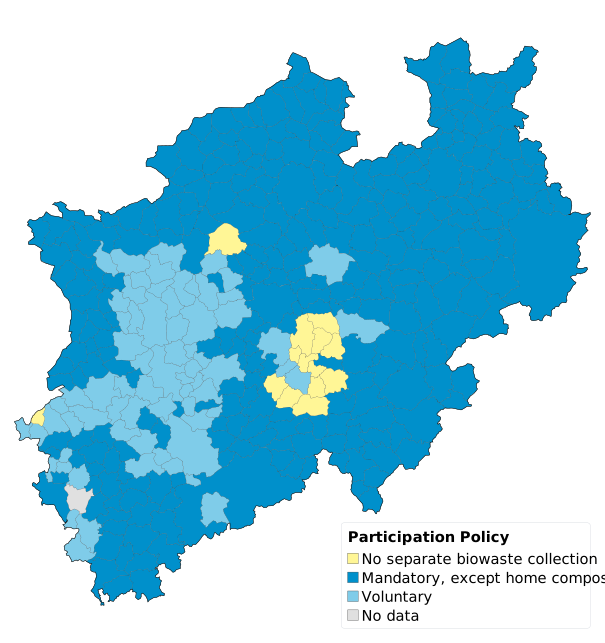
Voluntary participation is mainly located in the western part of NRW, where most of the large cities are located (Rhine-Ruhr metropolitan region).
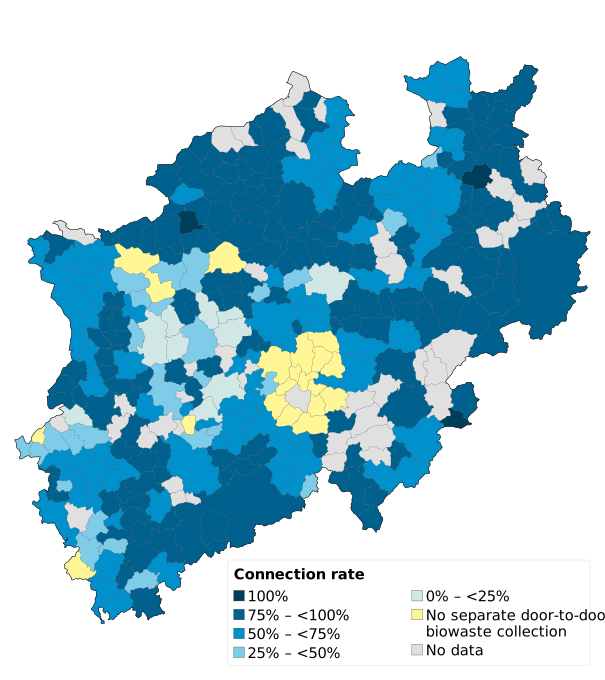
The population connection rate to biowaste separate collection follows a more diversified pattern compared to the participation policy. However, a pattern of higher connection rates in areas with mandatory participation policies compared to voluntary schemes can be identified.
Connection between participation policy and population connection rate
Figure 3 shows the distribution of connection rates by participation policy and for all collection areas combined. Mandatory schemes have a higher median connection rate and a considerably narrower distribution than voluntary schemes. Half of the connection rates under mandatory schemes range between 67% and 88%, compared with 33% to 82% under voluntary schemes.
Nevertheless, the participation policy does not fully determine the level of connection. Some collection areas with mandatory participation have comparatively low connection rates, including some values below 50%. One possible explanation is that exemptions for home composting are applied and controlled differently across the collection areas. In addition, specific neighbourhoods may be excluded from the mandate for practical reasons, such as logistical constraints, lack of space for biobins, or previous quality problems. At the same time, some voluntary schemes achieve connection rates close to 100%. This indicates differences between the formal participation policy and its practical implementation.
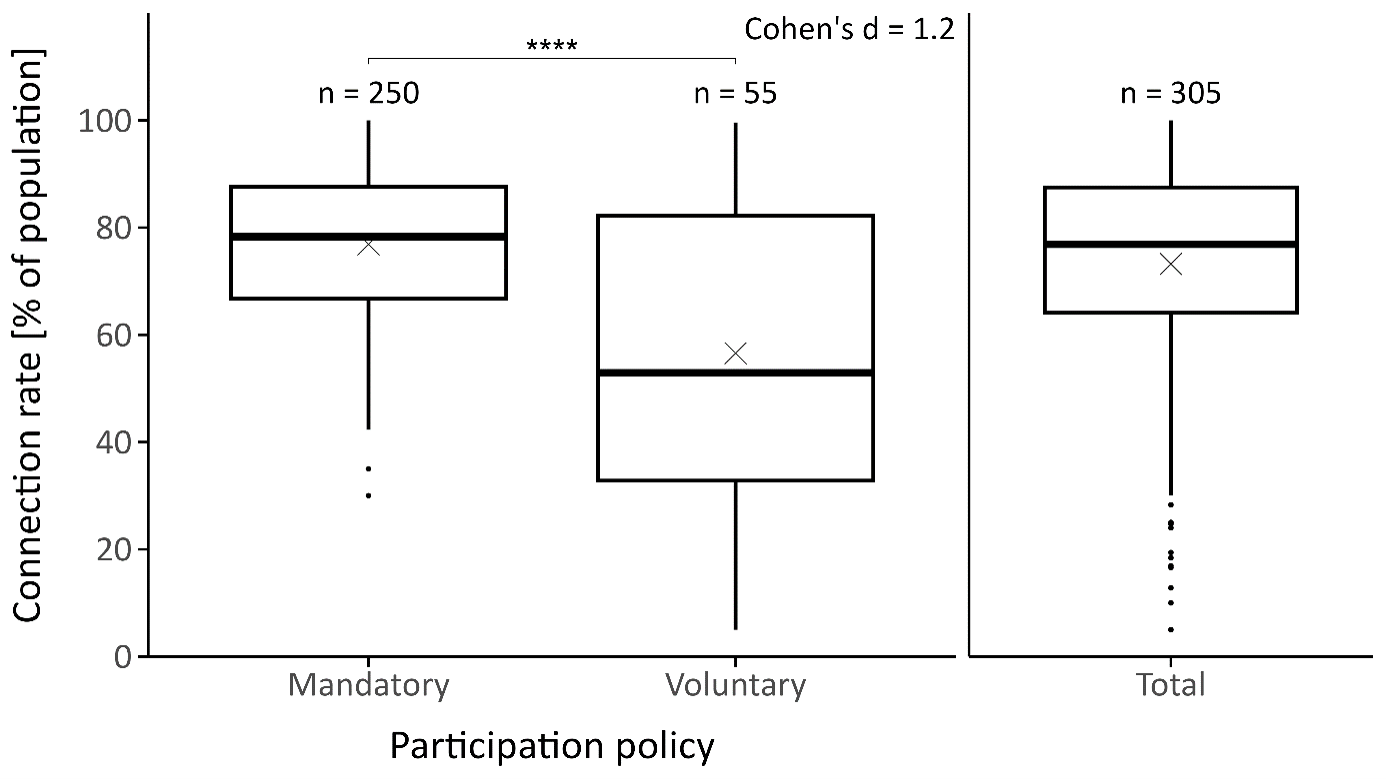
Overall, connection rates differ significantly between mandatory and voluntary schemes, with a large effect size (d = 1.2). Mandatory participation is therefore associated with substantially higher and more consistent population connection rates, but does not guarantee connection of the entire population.
This difference is also reflected in the weighted mean values. Collection areas with mandatory separate biowaste collection have a weighted mean connection rate of 77%, compared with 49% for voluntary schemes, resulting in the previously stated 64% of total weighted connection rate.
Statistical Assessment
The biowaste stream separation rate (SRBW,gross) was used as key performance indicator (KPI) for the statistical assessment. Figures showing the influence of the assessed influencing factors on biowaste and residual waste quantities are provided in the appendix (Download Factsheet PDF).
The first part of the assessment examines the influence of participation policy. The boxplots in Figure 4 indicate clear differences between mandatory and voluntary schemes. This finding is consistent with the higher connection rates identified in Figure 3.
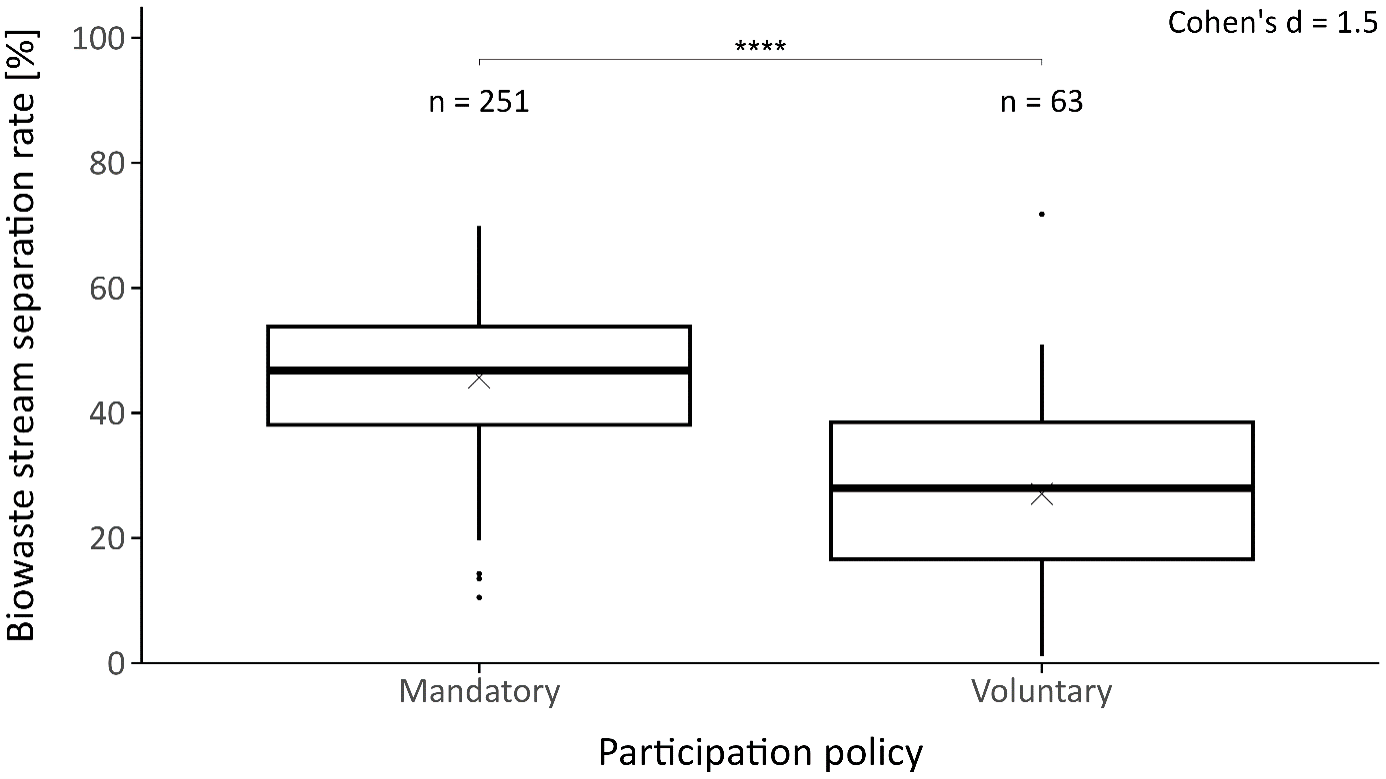
Mandatory participation policies are associated with higher separation rates. The median SRBW,gross is 47%, with a relatively narrow interquartile range (Q1 = 38%; Q3 = 54%). In contrast, voluntary schemes show a substantially lower median SRBW,gross of 28% (Q1 = 17%; Q3 = 39%). Although the distributions overlap and some voluntary schemes reach high separation rates, the overall distribution indicates that mandatory participation policies are generally linked to higher SRBW,gross.
The second part of the assessment examines the influence of the population connection rate. Since connection rate is a numerical influencing factor, the relationship is assessed using a scatter plot rather than grouped boxplots. The results indicate a strong positive relationship between both variables (Figure 5).
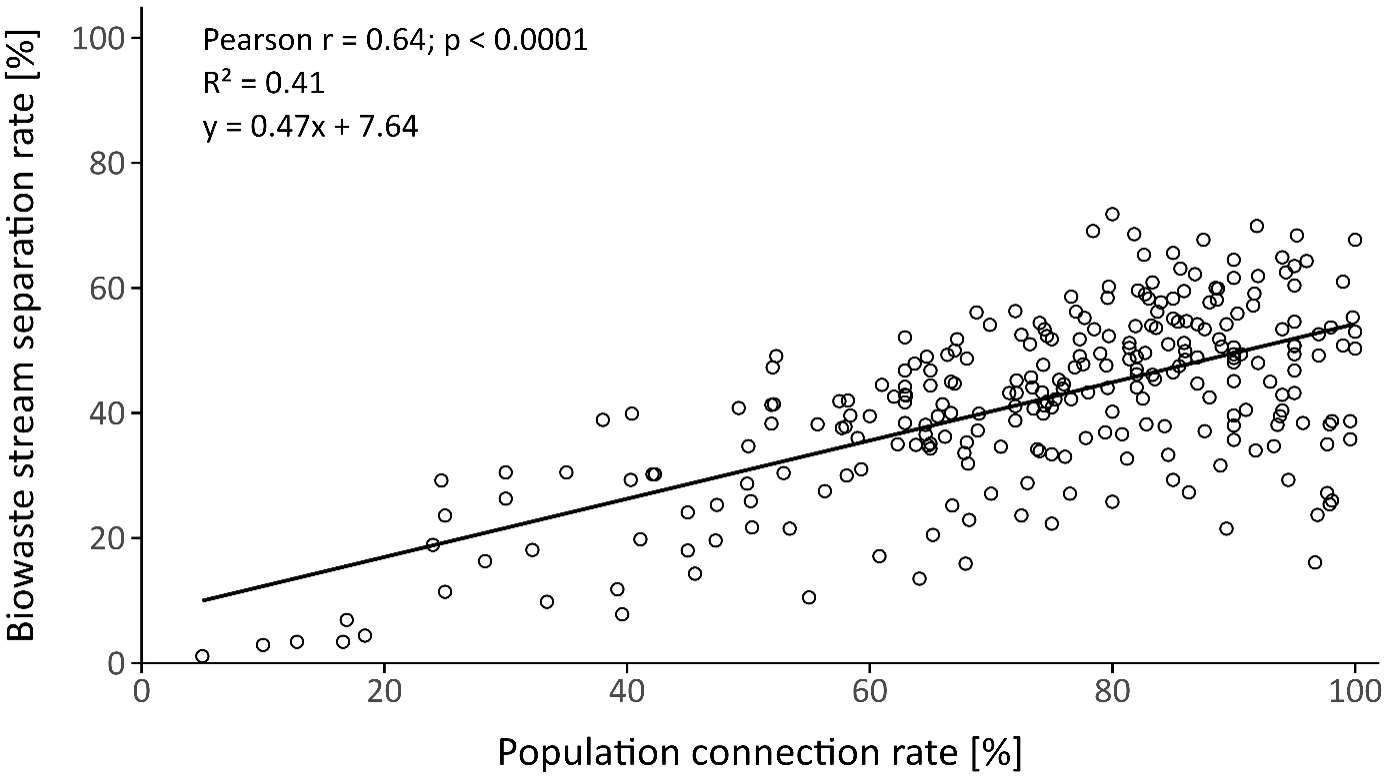
The plot shows that separation rates tend to increase with higher population connection rates. The linear trend indicates that collection areas with a larger share of the population connected to DtD biowaste collection generally achieve improved separation of biowaste from residual waste. However, the spread of values also indicates that connection rate alone does not fully explain the observed performance differences between collection areas.
Significance testing
For the participation policy, a t-test was used to compare the separation rates of mandatory and voluntary schemes. The difference between both groups is statistically highly significant (p < 0.001).
For the population connection rate, the relationship with SRBW,gross was assessed using Pearson correlation and linear regression. The Pearson correlation coefficient (r) indicates a strong positive linear association between both variables (r = 0.64, p < 0.001). The regression model also confirms a statistically significant positive relationship.
Effect size
The effect size for participation policy was assessed using Cohen’s d. The result indicates a very large effect (d = 1.5). This shows that the difference between mandatory and voluntary schemes is not only statistically significant, but also substantial in practical terms.
For the population connection rate, the strength of the relationship is reflected by the coefficient of determination (R2). The linear model explains around 41% of the variation SRBW,gross (R2 = 0.41). This can be interpreted as a large effect, indicating that the population connection rate is an important factor influencing the separate collection of biowaste. According to the model, each one percent point increase in population connection rate is associated with an average increase of approximately 0.5 percentage points in SRBW,gross.
Conclusion
Mandatory participation provides a stronger basis for connecting residents to separate biowaste collection than voluntary participation. However, the policy alone does not determine the resulting connection rate. While some mandatory schemes still have low connection rates, potentially due to exemptions for home composting, some voluntary schemes achieve connection rates close to full coverage. This indicates that, besides the legal implementation of separate collection, the way in which the service is introduced and promoted also plays an important role, for example whether residents must actively subscribe or receive a biobin automatically.
The statistical results indicate that both participation policy and the population connection rate to DtD biowaste collection are relevant influencing factors for biowaste separation performance. Mandatory schemes achieve significantly higher SRBW,gross values than voluntary schemes, with a very large effect. The population connection rate also shows a strong positive relationship with SRBW,gross. The estimated increase of 0.5 percentage points in SRBW,gross for each percentage-point increase in the connection rate provides a clear indication of practical relevance. This underlines that a mandatory policy should be combined with broad practical connection to the collection service and appropriate control of exemptions.
However, mandatory participation can be weakened if exemptions for home composting are granted without sufficient control. Evidence from residual waste composition data indicates that households declaring home composting may still dispose of considerably more biowaste within the residual waste stream. For example, the residual waste analysis in the region of Viersen showed a 13.5 percentage-point higher share of biowaste in residual waste for households declaring home composting compared to those with a biobin. Another German region found 0.34 kg of biowaste in residual waste per inhabitant and week for biobin users (23% of residual waste) and 0.64 kg per inhabitant and week for home composters (34% of residual waste stream). Therefore, home composting should remain possible, but it should not necessarily lead to full exclusion from the biowaste collection service. A smaller biobin or reduced minimum bin volume could provide a more balanced approach.