
Result Summary: This fact sheet examines the impact of the target waste category within the main collection system for biowaste (food waste or commingled biowaste) on the separation performance, using the Province of Bolzano – South Tyrol in Italy as a case study. While commingled biowaste collection achieves higher separation rates, targeted food waste collection also performs well and supports the separate treatment and valorisation of food and green waste.
Introduction
Target waste category refers to the type of organic waste accepted in the main separate biowaste collection system. This assessment distinguishes between systems targeting food waste and those collecting food and green waste together as commingled biowaste. Secondary systems include additional collection of green waste.
Depending on how strictly the system is implemented and followed by residents, the selected target category can directly influence the quantities and composition collected and the resulting biowaste separation rates.
The distinction is also relevant for treatment, as targeted food waste collection supports anaerobic digestion and potential post-composting, while separately collected green waste is mainly directed to composting.
Info: Terminologies are explained in the sections on Key Performance Indicators (KPI), Influencing Factors (IF) and Glossary on the project website: Link
Descriptive overview
Influencing factor overview
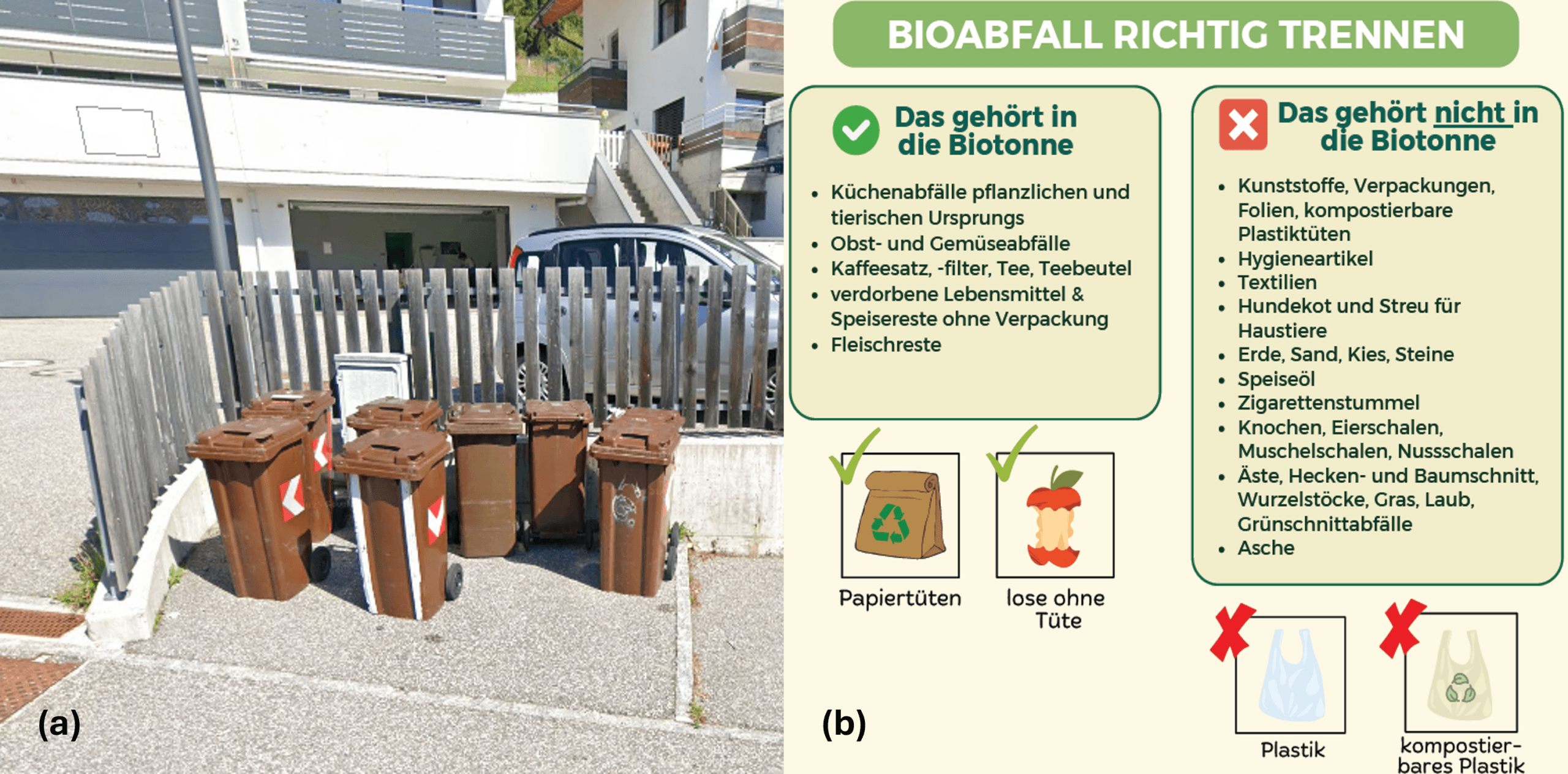
Most of the population was covered by a separate collection system targeting single-stream food waste in 2024. Overall, 60% of the population across 50 collection areas was covered by this system, while the remaining 40% across 55 areas collected biowaste as commingled stream. Figure 1 shows typical collection points for biowaste bins and the sorting instructions in areas with targeted food waste collection.
The instructions clearly exclude all garden waste from the collection. They also highlight the considerable effort and costs associated with collecting, transporting and treating green waste and therefore promote waste-prevention measures. These include robotic mowing or mulching and leaving grass clippings on the lawn, home composting or use in a manure heap, and using woody prunings as fuel in a suitable domestic stove where permitted.
Spatial distribution
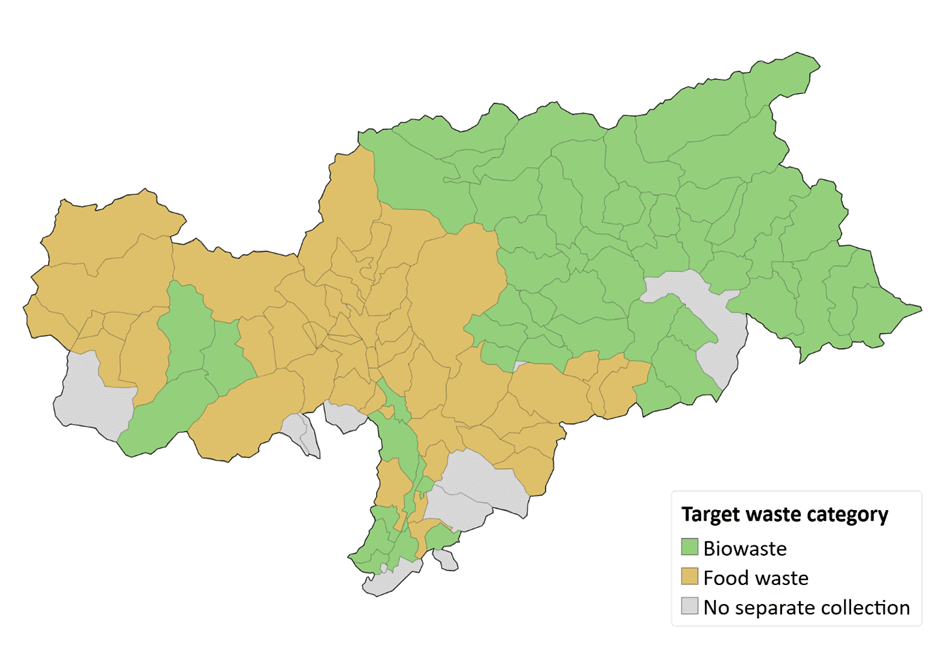
The spatial distribution shows that targeted food waste collection is concentrated mainly in the central and western parts of the province, while commingled biowaste collection is more common in northern and eastern areas.
Statistical Assessment
The biowaste stream separation rate (SRBW,gross), the total organics stream separation rate (SRTOS,gross) and the approximated net biowaste separation rate (SRBW,approx) were used as key performance indicators (KPI).
The boxplots in Figure 3 show differences in SRBW,gross between collection areas targeting different biowaste categories. Figures showing the influence of the assessed influencing factor on biowaste, green waste and residual waste quantities are provided in the appendix (Download Factsheet PDF).
Commingled biowaste collection shows the higher SRBW,gross among both categories, with a median of 45% (mean = 43%) and a relatively wide interquartile range (Q1 = 32%, Q3 = 54%). Targeted single-stream food waste collection results in a median of 30% (mean = 27%) and a narrower interquartile range (Q1 = 18%, Q3 = 35%).
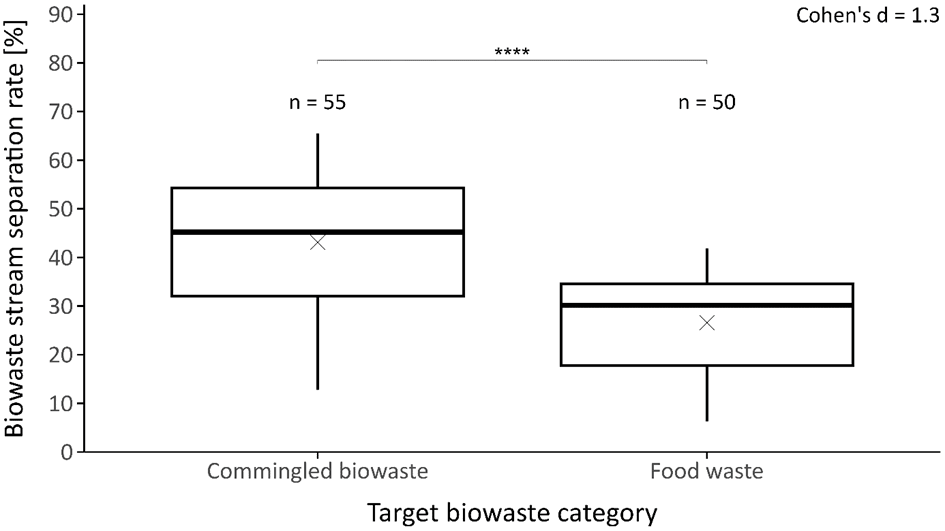
The differences indicate that targeting either commingled biowaste or single-stream food waste has an effect on SRBW,gross. It can be assumed, that green waste is likely not, or only partly, included in targeted food waste collection. The differences between the two categories can therefore largely be attributed to the additional green waste collected within the commingled biowaste stream.
SRTOS,gross, including biowaste stream and additional green waste stream, would be expected to be similar, assuming proper implementation of collection concepts for all waste streams. In areas collecting commingled biowaste, more green waste enters the biowaste stream and less is collected through separate green waste collection. In contrast, where food waste is the target category, a larger share of green waste would be expected to enter the separate green waste collection system.
However, the results show a similar pattern to SRBW,gross (Figure 4). Collection areas targeting commingled biowaste have a median SRTOS,gross of 54% (mean = 54%) compared with 42% (mean = 40%) for areas targeting food waste.
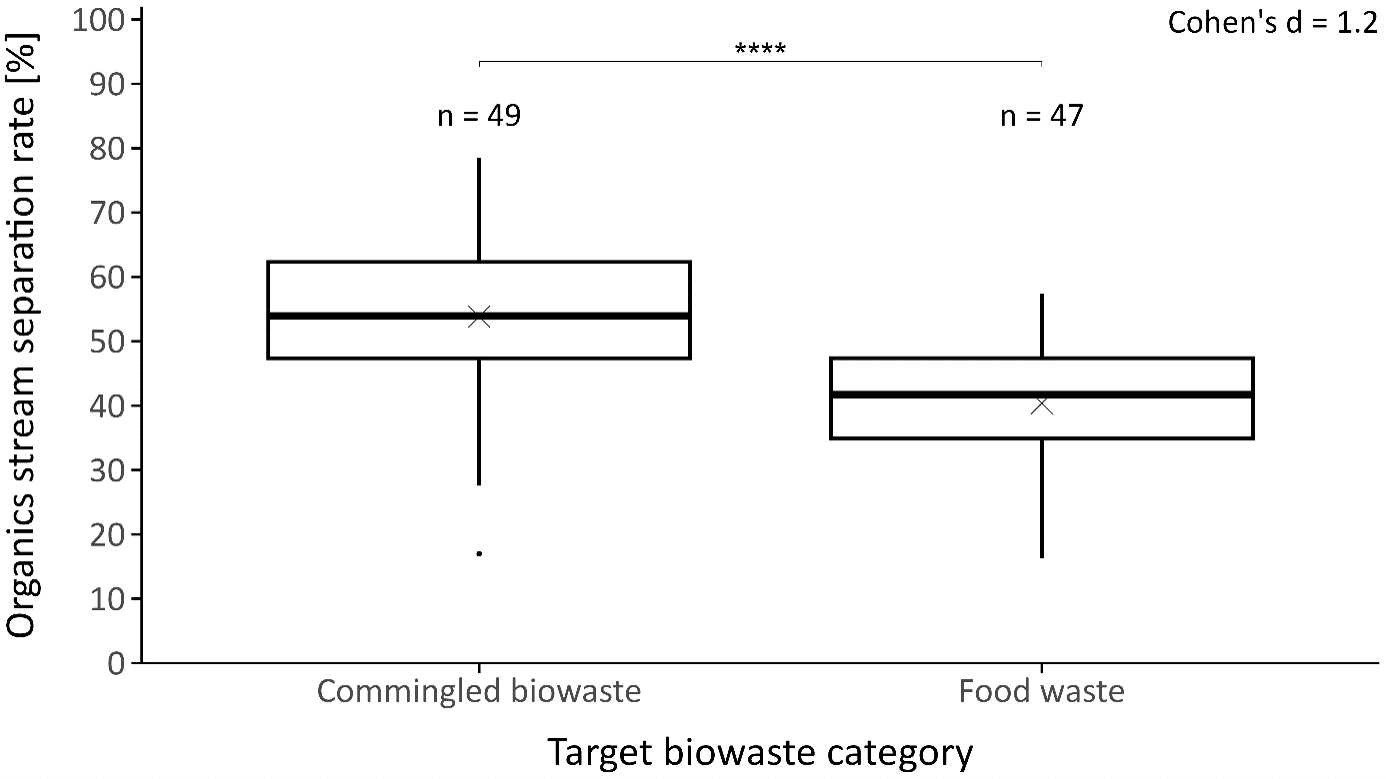
One possible explanation is that a larger share of green waste is managed outside the separate collection system. Among others, the sorting instructions (Figure 5) actively promote on-site management and waste-prevention measures. This may partly explain the lower quantities recorded in the collection statistics.
The assessment of SRBW,approx was based on the residual waste composition analyses presented in the case study profile of the Province of Bolzano – South Tyrol. While the results were only available as aggregated data for the eight district associations rather than for individual collection areas, the underlying composition analysis was based on a large number of samples, and seven of the eight districts could be clearly assigned to either targeted food waste or commingled biowaste collection.
The results indicate a similar pattern to the previous KPIs, although the difference was smaller. SRBW,approx was 89 ± 1% in areas targeting food waste and slightly higher at 93 ± 1% in areas collecting commingled biowaste.
It is also worth noting that total biowaste captured across the assessed waste streams (biowaste, green waste and residual waste) was 105 ± 18 kg inh-1 a-1 in areas targeting food waste, compared with 116 ±21 kg inh-1 a-1 in areas collecting commingled biowaste. These quantities do not include biowaste managed outside the municipal collection system, such as home composting.
Significance testing
The statistical analysis indicates significant differences between the two target waste categories for all three KPIs. Areas collecting commingled biowaste achieved higher separation rates than those targeting food waste throughout. The differences were highly significant for both the biowaste stream separation rate (SRBW,gross; p < 0.001) and the total organics stream separation rate (SRTOS,gross; p < 0.001). A significant difference was also found for the approximated net biowaste separation (SRBW,approx.; p <0.05), although this result should be interpreted more cautiously due to the aggregated district-level data.
Effect size
Large effect sizes were found for both SRBW,gross (Cohen’s d = 1.32) and SRTOS,gross (d = 1.23). This indicates that the target biowaste category is strongly associated with the observed differences in both separation rates.
An even larger effect was found for SRBW,approx (d = 3.54). However, this estimate is based on the aggregated district-associations-level data and has a wide confidence interval.
Conclusion
All three evaluated KPIs show the same general direction, with higher rates in areas collecting commingled biowaste. However, SRBW,approx provides a more complete picture of overall biowaste separation by also considering biowaste remaining in residual waste. Based on this KPI, both collection concepts achieve similarly high separation performance. Differences in the quantities captures by the municipal collection system should also be interpreted in light of home composting, which is promoted in many areas targeting food waste.
Targeted food waste collection nevertheless offers an important treatment advantage by keeping food waste and green waste apart. Food waste can first be directed to anaerobic digestion, while separately collected green waste can be composted directly. This allows treatment to be better adapted to the characteristics of each waste stream and supports the production of more specialised outputs, including biogas as well as compost from green waste only or from green waste mixed with digestate of anaerobic digestion of food waste.
Overall, both target categories can support effective biowaste separation. However, where anaerobic digestion is a central part of the local biowaste management concept, targeted food waste collection can make better use of a cascade approach by directing food waste to anaerobic digestion while keeping green waste available for composting directly. Appropriate management of green waste should therefore be considered as an integral part of the collection concept, either through separate collection or home composting. This approach is also in line with the broader development in the Province of Bolzano – South Tyrol, where several districts are adapting their systems to exclude green waste from the biowaste bin, as introduced in Pustertal/Valle Pusta from 2025 onwards.